
 By
By Introduction:-
What is AI?
I still remember the first time someone asked me, “What exactly is this AI thing everyone keeps talking about?” It was my neighbor in Ayodhya (India), during one of those hot summer evenings when the power had just come back after a two-hour cut. She had been watching news about ChatGPT and felt completely lost.
Her confusion made perfect sense. Artificial Intelligence gets thrown around in every conversation these days – from smartphone features to job market discussions to existential debates about humanity’s future. Yet most explanations either sound like science fiction or drown you in technical jargon that requires a computer science degree to decode.
Here’s the truth: AI is neither magical nor mysterious. It’s technology built on mathematics, data, and clever algorithms. Understanding AI for beginners doesn’t require you to become a programmer. You just need someone to explain it in plain language, with real examples from everyday life.
That’s exactly what this guide does. Whether you’re in Delhi struggling with slow Jio internet while trying to understand AI, or you’re in the USA or UK wondering how this technology affects your daily life, this explanation will make sense. No confusing terms. No assumptions about your technical background. Just practical clarity.
What you’ll learn in this guide: The real meaning of artificial intelligence beyond the hype, how AI actually works in systems you already use, the difference between AI myths and reality, practical examples you can relate to immediately, common mistakes beginners make when learning about AI, and what you actually need to know as an everyday user.
👉 Also Read – Blog 2: How Does Artificial Intelligence Work?
What is Artificial Intelligence? AI for beginners:

AI for beginners-
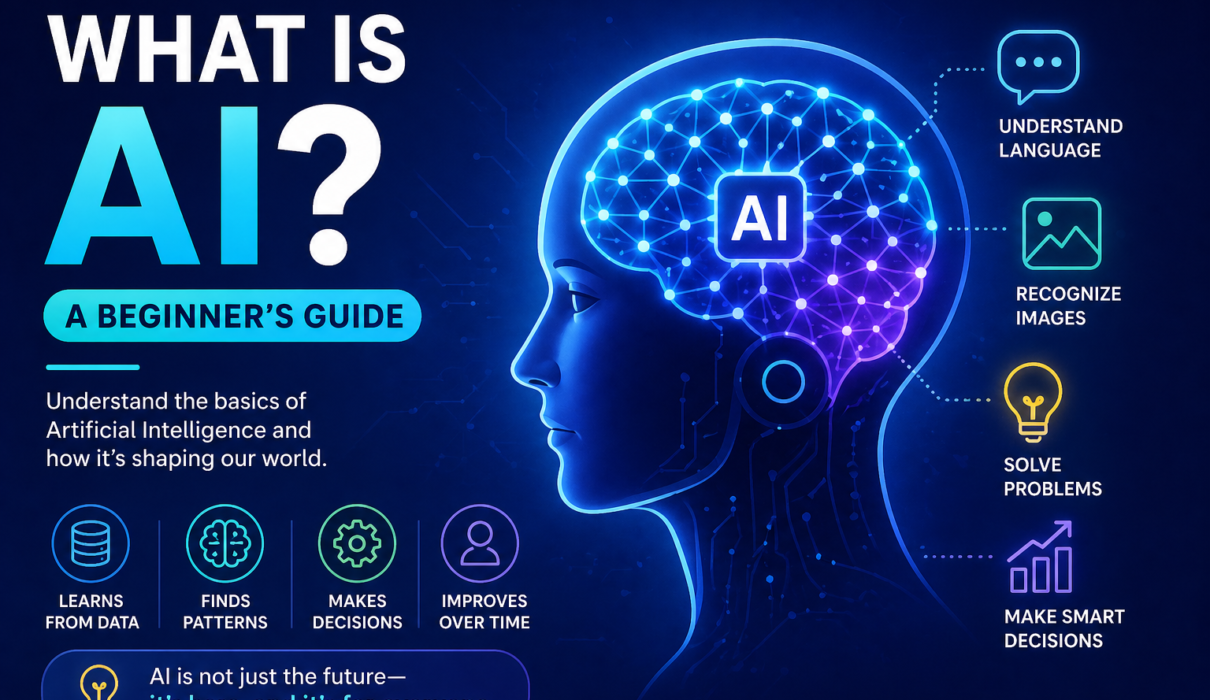
In simple terms, Artificial Intelligence is about creating machines that can think, learn, and make decisions like humans.
👉 Also see our next blog- Blog 2: How Does Artificial Intelligence Work?
Artificial Intelligence (AI) encompasses a range of technologies designed to emulate human cognitive functions. For beginners, understanding AI is crucial as it increasingly influences various aspects of daily life, from personal assistants to recommendation systems. This guide will demystify AI, presenting clear explanations, dispelling common myths, and offering practical insights. As you navigate the world of AI, you’ll gain valuable knowledge essential for engaging with this transformative technology.
What is AI? The honest and simple explanation-
Let me start with what artificial intelligence actually means without the marketing fluff.
Artificial Intelligence refers to computer systems designed to handle tasks that typically require human thinking. Instead of just following rigid, pre-programmed instructions like traditional software, AI systems can learn from experience, recognize patterns, and make decisions based on data.
Think of it this way: when you use a calculator, you type numbers and it follows exact formulas. That’s traditional programming. But when Netflix recommends shows based on what you’ve watched before, or when your phone’s camera automatically detects faces, or when Google translates languages – that’s AI at work. The system wasn’t given specific rules for every possible scenario. Instead, it learned patterns from millions of examples.
The key difference between AI and regular software lies in how they handle problems. Regular programs need explicit instructions for every situation. AI systems, however, figure things out by identifying patterns in data, much like how you learned to recognize your friend’s face by seeing them multiple times – not by someone giving you a mathematical formula.
AI for beginners.
What AI can do?

Here’s what AI can do:
- Recognize and understand human speech (like Siri or Alexa)
- Identify objects, faces, and scenes in images
- Read and comprehend written text
- Make predictions based on historical data
- Learn and improve performance over time
- Generate content like text, images, or music
For example, when your phone unlocks using face recognition or when a video platform suggests what to watch next—that’s AI in action.
In simple words:
👉 AI = machines that can think and learn (like humans, but differently)
AI for beginners.
A Simple Way to Understand AI
Think of AI like teaching a child.
Instead of programming every instruction, you give examples. Over time, the system learns patterns and improves.
For instance:
- Show many pictures of cats → AI learns what a cat looks like
- Feed customer data → AI predicts buying behavior
AI learns from data, not just instructions.
AI for beginners.
Simple Example of AI
Let’s make it easy.
When you:
- Watch videos on YouTube
- Get product suggestions on shopping apps
- Use voice assistants
👉 That’s AI working behind the scenes.
AI for beginners.
My Personal Journey Understanding AI (And the Mistakes I Made)
When I first started learning about AI back in 2022, I made every beginner mistake possible. I thought AI was a single software you could download. I believed it could “think” like humans. I even spent hours looking for an “AI application” to install on my laptop, not realizing AI is embedded in dozens of tools I was already using daily.
The turning point came when I was struggling to check whether my blog content was original or accidentally too similar to other sources. A fellow blogger recommended Originality.ai, an AI-powered tool that detects AI-generated content and plagiarism. Using it was my first hands-on experience with practical AI that solved a real problem.
What fascinated me wasn’t just that it worked – it was understanding how it worked. The tool wasn’t following a checklist of “bad writing patterns.” It had been trained on millions of text samples to recognize statistical patterns that distinguish human writing from AI-generated text. That’s when AI clicked for me: it’s pattern recognition at scale.
For beginners in the USA or UK, this example might seem specific to content creators, but the same principle applies everywhere. Whether it’s your email app filtering spam, your banking app detecting fraud, or your music app creating playlists – it’s all pattern recognition learned from massive datasets.
AI for beginners.
Traditional Programming vs AI: Understanding the Core Difference
This distinction confused me for months, so let me explain it clearly with a practical example.
Traditional Programming Approach
Imagine creating a program to identify spam emails. With traditional programming, you would write specific rules:
- If the subject line contains “You won a prize,” mark as spam
- If the sender address looks suspicious, mark as spam
- If the email has more than 10 exclamation marks, mark as spam
The problem? Spammers quickly learn these rules and change their tactics. You’d need to constantly update your rules manually, playing an endless cat-and-mouse game.
AI Approach
With AI, you feed the system thousands of examples of spam emails and legitimate emails. The system analyzes patterns across all examples – word choices, sentence structures, sender behaviors, timing patterns, link frequencies, and hundreds of other features you might never notice manually.
Then, when a new email arrives, the AI compares it against these learned patterns and calculates the probability it’s spam. As spammers change tactics, the AI automatically adapts by learning from new examples without anyone rewriting rules.
This learning-based approach makes AI powerful but also introduces new challenges like the need for quality training data and computational resources.
👉 Also read- Blog 3: Types of Artificial Intelligence Explained for Beginners: The complete Guide (2026)
Types of Artificial Intelligence
AI can be divided into three main categories:
1. Narrow AI (Weak AI)
This is every AI system you interact with today. Narrow AI is designed to perform specific tasks exceptionally well but cannot transfer that knowledge to other areas.
Real examples from my daily life in Delhi:
- Google Maps predicting traffic conditions (it’s brilliant at navigation but can’t help me write this blog)
- WhatsApp’s spam detection (catches spam messages but can’t compose replies for me)
- My phone’s facial recognition (unlocks my device but can’t recognize my dog)
- YouTube recommendations (knows what videos I’ll watch but can’t schedule my day)
Each system is exceptional at its specific job but completely useless outside its trained domain. That’s the “narrow” part – narrowly focused expertise.
2. General AI (Strong AI)
General AI would match human-level intelligence across all domains – learning new skills, transferring knowledge between tasks, understanding context, and solving unfamiliar problems without specific training. This doesn’t exist yet and might not exist for decades, if ever.
Despite what science fiction movies suggest, we’re nowhere near this. Every “smart” AI you see is actually narrow AI that’s very good at fooling us into thinking it’s more capable than it really is.
- It can perform multiple tasks (like humans).
- It is still under development.
3. Super AI
This refers to AI that would surpass human intelligence in every aspect. It’s theoretical, highly debated, and not relevant to understanding AI as it exists today. Don’t let fears about superintelligent robots distract from learning about the AI that actually affects your life right now.
- This is more advanced than human intelligence.
- This is theoretical for now.
AI for beginners.
👉 Also read- Blog 3: Types of Artificial Intelligence Explained for Beginners: The complete Guide (2026)
How Machine Learning Powers Modern AI
Machine learning is the engine behind most AI systems you encounter. Think of it as the method AI uses to learn from data rather than following programmed rules.
Here’s a simple breakdown of how it works:
Step 1: Collect Training Data
The system needs examples to learn from. For image recognition, that means thousands of labeled photos. For language translation, it needs millions of translated sentence pairs.
Step 2: Find Patterns
The AI analyzes this data looking for statistical relationships and patterns. It’s doing sophisticated mathematics to identify what features matter most for making accurate predictions.
Step 3: Build a Model
Based on discovered patterns, the system creates a mathematical model – essentially a formula that can make predictions on new, unseen data.
Step 4: Test and Refine
The model gets tested on data it hasn’t seen before. If performance is poor, the system adjusts and tries again until accuracy improves.
This process happens automatically once set up, which is why AI can improve over time without human intervention.
AI for Beginners.
Where Do We See AI in Daily Life?
Real-Life Examples of AI

Let me walk you through a typical day showing where AI actually shows up:
Morning: Your alarm goes off. You check your phone, and the keyboard app predicts the next word you’ll type in your message. That’s AI analyzing your typing patterns.
Commute: Google Maps suggests the fastest route based on real-time traffic analysis. AI is crunching data from millions of users to predict congestion patterns.
At Work: Your email client automatically sorts messages into Primary, Social, and Promotions tabs. AI learned to categorize emails based on content patterns.
Lunch Break: You browse Instagram and see a sponsored ad for exactly the type of shoes you were thinking about buying. AI analyzed your behavior patterns to determine what you might be interested in purchasing.
Evening: Netflix suggests a new series. Spotify creates a personalized playlist. Amazon shows “Customers who bought this also bought…” All AI-driven recommendations.
Night: Your bank sends an alert about unusual activity on your card. Fraud detection AI noticed a transaction pattern that didn’t match your normal behavior.
None of these feel like “artificial intelligence” because they work seamlessly in the background. That’s actually the mark of good AI – it’s invisible until you need it.
You may not notice it, but AI is everywhere.
AI for Beginners.
Benefits of Artificial Intelligence–
Artificial Intelligence (AI) offers many practical benefits to individuals, businesses, and society. By analyzing large amounts of data, automating repetitive work, recognizing patterns, and assisting with decisions, AI can help people work faster, smarter, and more efficiently. (IBM)
1. Automates Repetitive Tasks
AI can handle routine activities such as data entry, document processing, scheduling, and basic customer support. This saves time and allows people to focus on more creative and important work. (IBM)
2. Saves Time and Increases Productivity
AI tools can quickly summarize information, generate drafts, analyze data, write code, and assist with research. This can significantly reduce the time required for many everyday tasks. (IBM)
3. Helps Make Better Decisions
AI can process huge amounts of information and identify patterns that may be difficult for humans to spot. Businesses can use these insights for forecasting, planning, risk management, and decision-making. (IBM)
4. Reduces Human Errors
When properly designed and supervised, AI can help identify mistakes, flag unusual patterns, and perform repetitive processes consistently. This can be particularly useful in areas where accuracy is important. (IBM)
5. Provides 24/7 Assistance
Unlike human employees, AI systems can operate continuously. AI chatbots and virtual assistants can answer common questions and provide support outside normal working hours. (IBM)
6. Improves Personalization
AI can analyze user behavior and preferences to provide personalized recommendations. Examples include product recommendations, personalized learning experiences, search results, and content suggestions.
7. Helps Businesses Reduce Costs
By automating suitable tasks and improving workflows, AI can help organizations use their resources more efficiently. Small businesses can also use AI tools for activities such as customer service, content creation, bookkeeping support, and marketing. (IBM)
8. Supports Healthcare and Scientific Research
AI is being used in areas such as medical research, drug discovery, medical imaging, and scientific analysis. Its ability to process large datasets can help researchers discover patterns and possibilities more quickly. (IBM)
9. Improves Customer Experience
AI-powered chatbots and virtual assistants can provide quick responses to frequently asked questions. AI can also help businesses personalize interactions and identify customer needs. (IBM)
10. Improves Safety
AI can perform or assist with tasks that may be dangerous for humans, including certain industrial, underwater, high-altitude, or hazardous environments. This can reduce people’s exposure to physical risks. (IBM)
11. Supports Learning and Education
Students can use AI to explain difficult concepts, generate practice questions, summarize lessons, brainstorm ideas, and receive personalized learning assistance. However, AI-generated information should still be checked for accuracy.
12. Encourages Innovation
AI can help people experiment with ideas more quickly—from creating content and software to analyzing scientific problems. This can lower the barrier to trying new concepts and developing new products and services. (IBM)
In Simple Words
The biggest benefits of AI can be summarized as:
AI helps us save time, automate repetitive work, analyze information, make better-informed decisions, improve accuracy, personalize experiences, increase productivity, and tackle complex problems.
However, AI isn’t automatically beneficial in every situation. It can also create challenges involving privacy, security, bias, errors, and employment, so responsible human oversight remains important. (IBM)
AI for Beginners.
Is AI Difficult to Learn?
Many beginners assume AI is only for programmers or experts. That’s not true.
Today, you can:
- Use AI tools without coding
- Learn basics through free resources
- Start with simple concepts
The key is to start small and stay consistent.
Common Misconceptions About AI
Let’s clear a few myths:
- “AI will replace all jobs” → AI changes jobs, not eliminates all
- “AI is too technical” → Beginners can learn step by step
- “AI is only for big companies” → Anyone can use AI tools today
AI for beginners.
Final Thoughts
Artificial Intelligence is no longer just a futuristic idea—it is becoming an important part of everyday life, from search engines and smartphones to education, business, healthcare, and creative tools. (OpenAI)
For beginners, the most important thing is to understand that AI is a broad field of technology, not a single tool or application. Machine learning, deep learning, generative AI, and large language models are different technologies and approaches within the wider AI landscape. (OpenAI)
You don’t need to become a programmer or AI expert to start. Begin by understanding the fundamentals, experiment with AI tools, learn how to use them responsibly, and gradually explore more advanced concepts.
The future of AI is being built today, and the best time to start learning is now. Whether you want to improve your productivity, develop new skills, prepare for future career opportunities, or simply understand the technology around you, learning the basics of AI is a valuable first step.
Keep learning, keep experimenting, and don’t be afraid to start small. Your AI journey begins with understanding the basics.
Hope you like the blog- What is AI? AI for beginners.
Call to Action
If you’re just starting, don’t miss our next blogs:
Follow NextGenAIToolNest for more AI guides, automation tips, and online earning strategies.
24 Comments