
 By
Introduction: The Growing Role of AI in Education
Artificial intelligence (AI) is changing how people learn, teach, and access educational resources. From personalized learning applications to AI-powered tutoring assistants, technology is creating new opportunities for students and teachers around the world.
AI in education refers to the use of artificial intelligence technologies to support teaching, learning, assessment, educational administration, and student support. These technologies can analyze information, generate explanations, identify learning patterns, and help educators prepare educational materials more efficiently.
For example, a student who struggles with mathematics can use an AI-powered learning assistant to receive step-by-step explanations. A teacher can use AI to prepare lesson plans, create quizzes, or develop different versions of a worksheet for students with different learning needs.
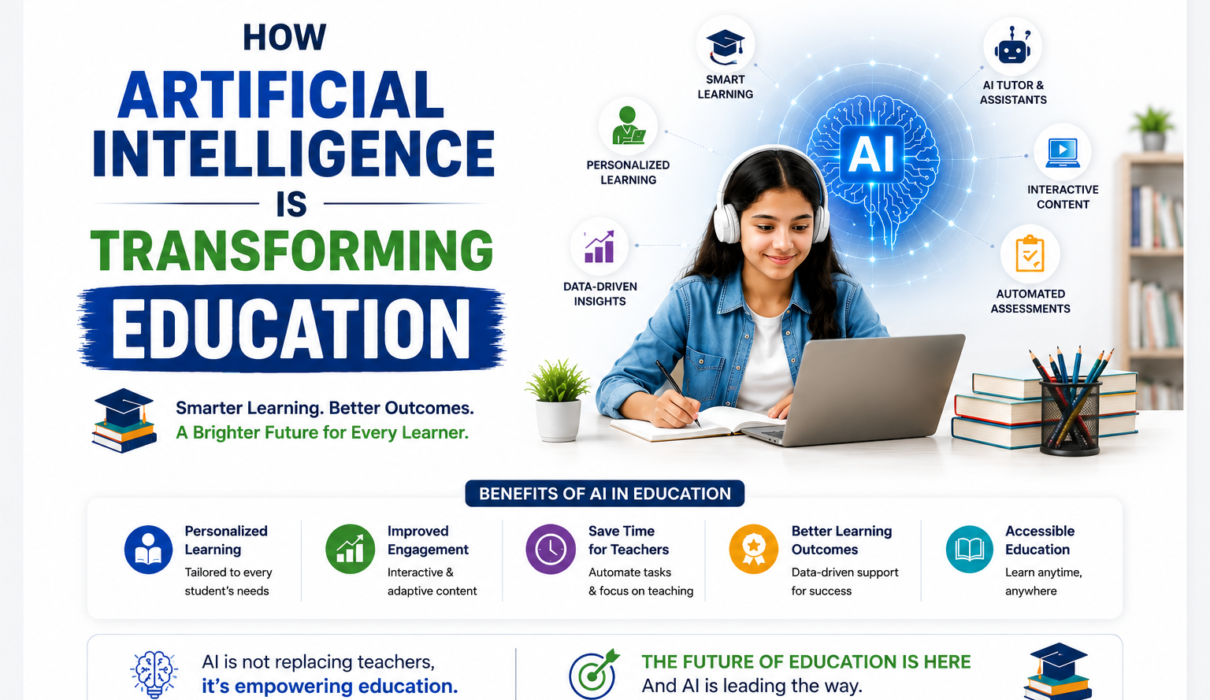
However, artificial intelligence is not a replacement for teachers. Its greatest potential lies in supporting educators and helping students become more confident, independent learners.
According to UNESCO’s overview of artificial intelligence in education, AI has the potential to address educational challenges and improve teaching and learning, provided its use is guided by inclusion, equity, and a human-centered approach.
In this guide, you will discover how artificial intelligence is transforming education, its major benefits, practical applications, challenges, and what the future may look like.
AI in education.
What Is AI in Education?
AI in education means using computer systems that can perform tasks such as recognizing patterns, processing language, generating content, and providing recommendations to support educational activities.
Unlike traditional educational software, some AI systems can adapt their responses based on the information users provide. For instance, a generative AI assistant can explain a difficult scientific concept in simpler language or create practice questions based on a student’s current understanding.
Common applications of AI in education include:
- Personalized learning platforms
- AI-powered tutoring assistants
- Automated feedback and selected grading tasks
- Language learning and translation tools
- Lesson planning and educational content creation
- Accessibility tools for students with disabilities
- Learning analytics and administrative support
To understand the technology behind these applications, read our guide on What Is Artificial Intelligence? A Beginner’s Guide and How Does Artificial Intelligence Work?
AI in education.
1. Personalized Learning for Every Student
One of the most promising benefits of AI in education is personalized learning.
In a traditional classroom, teachers often need to explain the same topic to many students at once. However, students learn at different speeds and may need different levels of explanation, practice, and support.
AI-powered learning platforms can use available learning information to recommend exercises, adjust the difficulty of activities, or provide additional explanations. Some systems can help identify topics a student may need to practise further.
For example, imagine two students learning fractions. One understands the basics quickly, while the other needs more examples. A suitable AI learning tool may recommend advanced problems for the first student and additional guided practice for the second.
This approach can help students learn at a comfortable pace.
However, personalized recommendations are not always accurate. Teachers should review important learning decisions and ensure that students are not unfairly limited by automated assessments or incomplete data.
Artificial Intelligence in education.
2. AI-Powered Tutoring and Homework Support
Artificial intelligence is making educational assistance available beyond traditional classroom hours.
AI tutoring assistants can explain concepts, answer questions, suggest practice exercises, and guide students through difficult topics. A student studying biology, for example, can ask for a simple explanation of photosynthesis and then request a quiz to test their understanding.
These tools may be particularly helpful for learners who need repeated explanations or want to revise a topic independently.
Students can use AI responsibly by asking questions such as:
- Explain this concept in simple language.
- Give me an example of how this formula works.
- Ask me five questions about this chapter.
- Help me understand where my solution went wrong.
- Give me hints rather than the complete answer.
The key is to use AI as a learning partner instead of a shortcut for completing assignments.
Students should verify important facts, consult textbooks, and follow their school’s rules about AI-assisted work. AI-generated answers can contain mistakes, misleading explanations, or invented references.
For more background, explore our article on What Is ChatGPT and How Does It Work?.
AI in teaching.
3. Helping Teachers Prepare Lessons More Efficiently
Teachers spend considerable time planning lessons, preparing worksheets, creating quizzes, and adapting materials to different learning levels.
AI tools can help with some of these tasks. For example, an educator might use an AI assistant to draft a lesson outline, generate discussion questions, summarize a long reading passage, or prepare a first version of a classroom activity.
A teacher teaching environmental science could ask an AI tool to create ten age-appropriate questions about climate change. The teacher can then review the questions, correct errors, and adapt them to the curriculum.
Potential benefits include:
- Faster preparation of initial teaching materials
- More options for classroom activities
- Different explanations of difficult concepts
- Draft quizzes and practice questions
- Support for differentiated instruction
AI-generated materials should always be checked for accuracy, age suitability, bias, and alignment with learning objectives. Teachers remain responsible for deciding what is appropriate for their students.
The U.S. Department of Education’s report on AI and the future of teaching and learning discusses opportunities and considerations for integrating AI into education.
AI in teaching.
4. Improving Accessibility and Inclusive Education
AI can help make educational resources more accessible to learners with different needs.
Speech-to-text tools can turn spoken words into written text, while text-to-speech applications can read digital material aloud. Translation tools can help learners understand content in another language, and some AI-powered systems can assist with captions, simplified explanations, and alternative ways of presenting information.
These features may support students with visual, hearing, language, or certain learning difficulties, depending on the tool and the individual student’s needs.
For example, a learner who finds a long passage difficult to read may benefit from an audio version. A student learning in a second language may use an AI assistant to explain unfamiliar vocabulary.
Nevertheless, accessibility features should be tested with the people who need them. AI tools do not automatically meet every learner’s requirements, and schools must consider affordability, privacy, reliability, and compatibility with assistive technologies.
UNICEF’s guidance on AI and children highlights the importance of children’s rights, safety, inclusion, and privacy when AI systems affect young people.
AI in education.
5. Making Assessments and Feedback More Useful
AI can support assessment by helping teachers create practice tests, identify common errors, and provide feedback on selected types of student work.
For example, an AI tool might identify that a student repeatedly makes mistakes when solving equations. The teacher could use this information to provide additional practice and explain the underlying concept.
Automated feedback can also help students revise drafts, improve grammar, or identify areas where an explanation needs more detail.
However, automated grading has limitations. AI may misunderstand a student’s reasoning, misjudge creative work, or produce inconsistent results. Written assignments can also be difficult to assess fairly using automated systems alone.
For these reasons, AI should be used cautiously in high-stakes examinations, admissions decisions, and other situations where an incorrect assessment could significantly affect a student’s future.
Human review, transparent assessment criteria, and opportunities to challenge errors remain essential.
Benefits of AI in education.
6. Supporting Language Learning and Communication
Learning a new language requires regular practice, feedback, and opportunities to use unfamiliar vocabulary.
AI-powered language tools can support these activities by generating conversations, explaining grammar, suggesting vocabulary exercises, and helping learners practise pronunciation when the application supports speech recognition.
For example, a beginner learning English can ask an AI assistant to conduct a simple conversation about daily routines. The learner can request corrections and ask why a particular phrase is more natural than another.
AI can also help teachers prepare multilingual learning resources and explain difficult terms.
However, translations and language feedback may not always capture cultural context, regional usage, or subtle meanings. Learners should compare important translations with trusted language resources and human guidance when necessary.
Benefits of AI in education.
7. Helping Students Develop Critical Thinking and Problem-Solving Skills
AI can support active learning when students use it to investigate ideas rather than simply accept its answers.
Students might ask an AI assistant to compare two scientific explanations, suggest arguments on both sides of a debate, or provide hints for solving a problem. They can then evaluate the evidence, identify weaknesses, and develop their own conclusions.
For example, a student writing about renewable energy could ask AI to list possible advantages and disadvantages. The student should then consult reliable sources, examine the evidence, and write an independent analysis.
This process can encourage questioning, research, and critical thinking.
On the other hand, copying AI-generated answers without checking them may reduce independent effort. Teachers and parents should help students understand that AI outputs need evaluation and that original thinking remains important.
Artificial Intelligence in education.
8. Practical Examples of AI in Education
Artificial intelligence is already used in different types of educational activities. The following examples illustrate common applications rather than guarantees of improved results.
| Educational area | Example of AI use | Potential benefit |
|---|---|---|
| School learning | Adaptive practice exercises | Practice suited to learning needs |
| Homework | Guided explanations and hints | Additional learning support |
| Teaching | Draft lesson plans and quizzes | Reduced preparation time |
| Language learning | Conversation practice and translation | More opportunities to practise |
| Accessibility | Captions and text-to-speech | Alternative ways to access content |
| Assessment | Draft feedback and error analysis | Faster identification of areas to review |
| Administration | Drafting routine communications | Less time spent on repetitive tasks |
The value of each application depends on its accuracy, design, accessibility, and the way educators and students use it.
9. Benefits of AI in Education
When carefully implemented, AI can provide several potential benefits.
More individualized learning
AI tools can help students receive explanations, exercises, and feedback suited to their learning needs.
Greater access to educational support
Digital learning assistants may provide help outside normal classroom hours, although access depends on internet connectivity, device availability, and affordability.
Improved teacher productivity
AI can assist with drafting teaching materials and handling selected repetitive tasks, leaving educators more time for student interaction and lesson improvement.
Faster practice and feedback
Some applications can provide immediate responses to practice questions and help students identify mistakes.
More accessible learning materials
Speech tools, captions, translation, and alternative content formats can help some students access information in ways that work better for them.
Opportunities to develop digital skills
Learning to use AI responsibly can help students understand emerging technologies and prepare for a world in which AI literacy is increasingly relevant.
For a broader overview of the technology, read our guide to the benefits of artificial intelligence.
Read our guide on Benefits of Artificial Intelligence to understand more about the benefits of AI.
Benefits of AI in education.
10. Challenges and Risks of AI in Education
Despite its potential, AI in education also presents important challenges.
Incorrect information
Generative AI systems can produce convincing but inaccurate answers. Students may learn incorrect facts if they trust these answers without verification.
Student privacy
Educational AI tools may collect personal information, learning records, or user-generated content. Schools and families should understand what information is collected, how it is stored, and whether it is used to train other systems.
Students should avoid entering passwords, private school records, sensitive personal information, or other confidential details into unapproved tools.
Academic dishonesty
Students may use AI to generate essays or complete assignments without doing the required work. Schools should explain which uses are permitted, how AI assistance should be acknowledged, and what constitutes original work.
Bias and unfair outcomes
AI systems can reflect biases in their training data or design. This can lead to inappropriate feedback or unequal outcomes for different groups of students.
Digital inequality
Not every student has a reliable internet connection, a suitable device, or access to paid AI services. If schools rely too heavily on AI, existing educational inequalities may become worse.
Overdependence on technology
Students who depend on AI for every explanation or assignment may miss opportunities to practise independent reasoning, writing, and problem-solving.
The UNESCO guidance on AI and education provides further discussion of the opportunities and risks associated with integrating AI into educational systems.
11. How Students Can Use AI Responsibly
Students can gain useful support from AI while protecting their learning and academic integrity.
Here are seven practical guidelines:
- Use AI to understand concepts. Ask for explanations, examples, hints, and practice questions instead of simply requesting completed assignments.
- Verify important information. Check factual claims against textbooks, teacher-provided materials, and trustworthy sources.
- Follow school policies. Ask teachers which tools and forms of AI assistance are permitted.
- Protect personal information. Do not enter confidential details into AI applications without appropriate authorization.
- Think independently. Form your own opinion before accepting an AI-generated recommendation.
- Disclose AI assistance when required. Follow the rules for acknowledging AI contributions in assignments and research.
- Keep practising essential skills. Continue developing writing, mathematics, research, communication, and problem-solving abilities without relying entirely on AI.
Parents and teachers can help children learn these habits by discussing both the benefits and limitations of AI.
12. The Future of AI in Education
The future of education will likely involve a combination of human teaching, digital resources, and AI-supported learning. As technology develops, educational applications may become more capable of supporting interactive lessons, multilingual learning, accessibility, and administrative work.
However, the success of AI in education should not be measured simply by how many schools adopt new tools. It should be measured by whether students learn effectively, teachers receive meaningful support, educational opportunities become more inclusive, and students’ rights are protected.
Schools will need clear policies, teacher training, suitable infrastructure, and regular evaluation of educational technologies. They should also consider whether an AI application genuinely improves learning before adopting it widely.
The UNICEF guidance on AI and children offers useful principles for considering safety, fairness, transparency, inclusion, and children’s well-being.
Ultimately, AI should strengthen the relationship between teachers and students, not replace the human guidance, encouragement, and understanding that make education meaningful.
Conclusion: Is AI Transforming Education for the Better?
Artificial intelligence is creating new possibilities for personalized learning, tutoring, lesson preparation, accessibility, language practice, and educational feedback. Used thoughtfully, these tools can help students learn at their own pace and help teachers manage selected tasks more efficiently.
At the same time, AI introduces risks involving inaccurate information, privacy, bias, academic dishonesty, and unequal access. These challenges require responsible policies, human oversight, and clear guidance for students and teachers.
The most effective approach is to treat AI as a tool that supports learning rather than a replacement for effort, curiosity, or human expertise.
For beginners, understanding AI in education is a useful first step toward understanding how artificial intelligence is changing everyday life.
Start learning today: Explore our beginner-friendly guides to artificial intelligence, how AI works, and AI tools for beginners to discover more ways this technology can be used responsibly.
Frequently Asked Questions (FAQs)
1. What is AI in education?
AI in education is the use of artificial intelligence to support teaching, learning, assessment, accessibility, and educational administration. Examples include AI tutors, adaptive learning tools, language assistants, and automated feedback systems.
2. How does AI help students learn?
AI can explain difficult concepts, generate practice questions, provide feedback, support language learning, and recommend additional exercises. Students should still verify information and complete their own learning activities.
3. Can AI replace teachers?
AI can assist with certain teaching tasks, but it cannot fully replace the human judgment, emotional support, classroom management, mentorship, and relationships that teachers provide.
4. What are the main benefits of AI in education?
Potential benefits include personalized learning, additional tutoring support, faster preparation of educational materials, accessibility features, language practice, and feedback on selected learning tasks.
5. What are the risks of AI in education?
Major risks include inaccurate answers, privacy concerns, algorithmic bias, academic dishonesty, overdependence, and unequal access to technology.
6. How can teachers use AI effectively?
Teachers can use AI to draft lesson plans, generate practice questions, adapt explanations, and support selected administrative tasks. They should review AI-generated content for accuracy, fairness, and suitability before using it.
7. Is AI in education useful for beginners?
Yes. Beginners can use suitable AI tools to understand unfamiliar concepts, practise skills, and explore new subjects. They should use age-appropriate tools, protect personal information, and follow their institution’s rules.
Call to Action
Hope you like our Blog: How AI is transforming Education (AI in Education).
For more AI related blogs do follow us on NextGenAIToolNest.