
 By
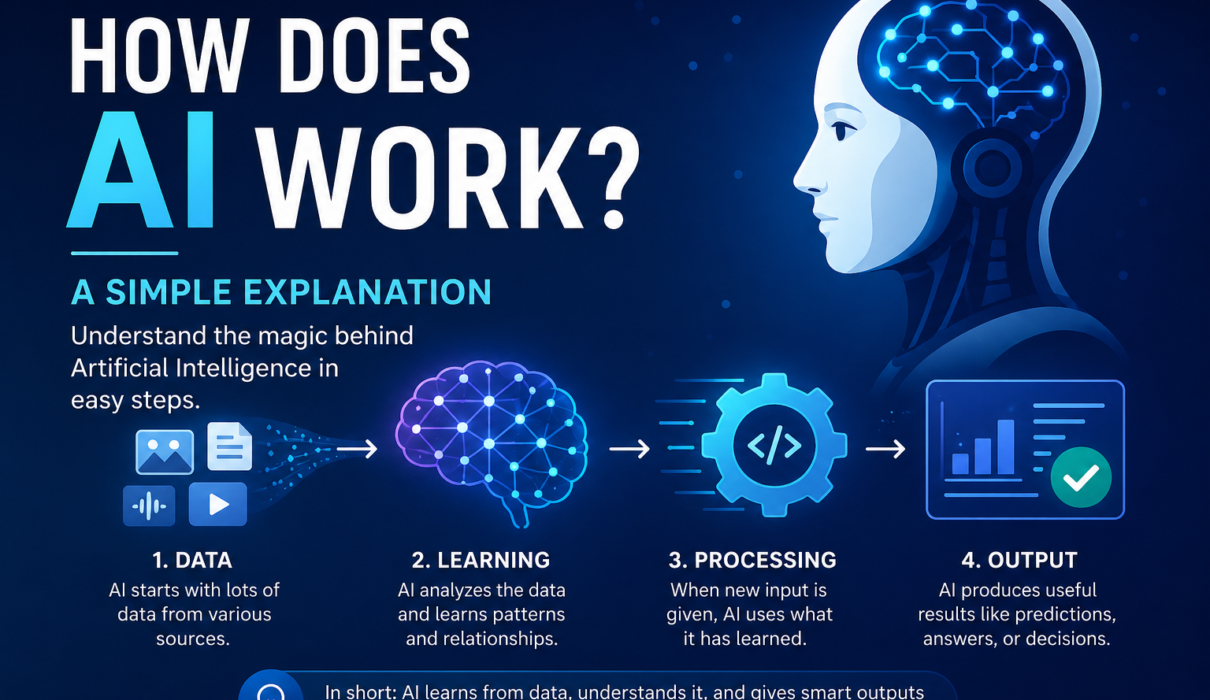
By How does AI work.
Artificial Intelligence (AI) has become part of everyday life. From voice assistants and recommendation systems to ChatGPT, smart cameras, navigation apps, and fraud detection, AI is helping computers perform tasks that once required human intelligence.
Before understanding how AI works, it is helpful to understand [what Artificial Intelligence actually is].
But how does artificial intelligence work?
At a basic level, AI works by combining data, algorithms, computing power, and mathematical models to identify patterns and produce useful outputs. Depending on the system, AI can recognize images, understand language, make predictions, generate content, recommend products, or help people make decisions.
The good news is that you don’t need to be a programmer or mathematician to understand the basics.
In this beginner-friendly guide, we’ll explain how artificial intelligence works, how AI learns from data, what machine learning and neural networks do, how generative AI works, and where AI is used in real life.
What Is Artificial Intelligence?
Artificial Intelligence explained-
Before understanding how AI works, it’s important to understand what AI actually means.
Artificial Intelligence is a broad field of computer science focused on creating systems that can perform tasks associated with human intelligence. These tasks can include:
- Learning from information
- Recognizing patterns
- Understanding language
- Recognizing images and sounds
- Making predictions
- Solving problems
- Generating content
- Supporting decisions
For example, when your phone recognizes your face to unlock the screen, an AI system analyzes visual information and compares it with learned patterns.
Similarly, when a streaming service recommends a movie, an AI-powered recommendation system can analyze information about your viewing behavior and identify patterns that may help predict what you might enjoy.
Artificial Intelligence enables computers and machines to perform tasks associated with learning, problem-solving, decision-making, and language understanding. For a broader introduction, see IBM’s guide to Artificial Intelligence.
AI doesn’t necessarily “think” like a human. Instead, different AI systems use different computational methods to process information and produce outputs.
AI can be categorized into different types based on its capabilities and functionality. Learn more in our guide to [the different types of Artificial Intelligence].
How Does Artificial Intelligence Work?

The simplest way to understand how artificial intelligence works is to think of it as a process:
Data → Processing → Learning → Pattern Recognition → Prediction/Decision → Output
An AI system generally receives information, processes that information using algorithms and models, identifies patterns, and then produces an output.
For example, imagine an AI system designed to identify cats in photographs.
First, it needs many examples of images. These images contain different cats, backgrounds, lighting conditions, sizes, and positions.
During training, the AI model analyzes patterns in those examples. Eventually, when presented with a new photograph, it can estimate whether the image contains a cat.
The process is much more complicated mathematically, but this basic concept makes how AI works for beginners easier to understand.
How Artificial Intelligence works for beginners.
1. AI Starts With Data
Data is one of the most important ingredients in modern AI.
AI systems can work with many types of data, including:
- Text
- Images
- Audio
- Video
- Numbers
- Sensor readings
- User interactions
- Documents
- Transaction records
For example, an AI system designed for image recognition might be trained using millions of images.
A language model may be trained using large collections of text and other data sources.
A recommendation system can analyze information such as:
- What users watch
- What they search for
- What they purchase
- What they click
- How long they interact with particular content
The quality, relevance, and preparation of data can have a major impact on an AI system’s performance.
Why Is Data Important?
Imagine teaching someone to identify different types of fruit.
If you only show them five pictures of apples, they may struggle when they encounter an apple with a different color, size, or shape.
Providing more varied examples can help them understand the broader patterns.
AI systems similarly benefit from appropriate and representative training data.
2. AI Uses Algorithms
The next important part of understanding how artificial intelligence works is algorithms.
An algorithm is essentially a set of instructions or procedures used to solve a problem or process information.
AI uses algorithms to perform tasks such as:
- Finding patterns
- Classifying information
- Making predictions
- Optimizing decisions
- Processing language
- Recognizing objects
Different problems require different approaches.
For example, an algorithm designed for image classification may be very different from one used for recommending products.
In machine learning, algorithms help models learn patterns from data rather than requiring programmers to manually write every possible rule.
3. Machine Learning Helps AI Learn From Data
Machine learning is one of the most important concepts in modern AI.
Machine learning is closely related to AI and deep learning, but these terms don’t mean exactly the same thing. Read our [beginner-friendly comparison of AI, Machine Learning, and Deep Learning] to understand the differences.
Machine learning (ML) is a branch of AI in which computer systems learn patterns from data and use those patterns to make predictions or decisions.
Instead of programming every rule manually, developers provide data and a learning method that allows the model to identify useful relationships within that data.
For example, suppose you want to create an AI system that predicts whether an email is spam.
You could provide the model with many examples of emails labeled:
- Spam
- Not spam
The machine-learning system can analyze patterns in those examples.
It might learn that certain combinations of words, links, formatting patterns, or sender characteristics are associated with spam.
When a new email arrives, the model can use what it learned to estimate whether that email is likely to be spam.
This is a simplified example, but it illustrates a fundamental idea behind how AI works.
Machine learning allows computer systems to learn patterns from data rather than requiring every rule to be manually programmed. Beginners who want to explore machine learning in more depth can use Google’s Machine Learning Crash Course.
4. Training an AI Model
The process through which an AI model learns from data is commonly called training.
During training, the model processes examples and adjusts internal parameters to improve its performance on a particular task.
Think of it like practice.
If a student repeatedly solves mathematics problems and learns from mistakes, their performance may improve.
An AI model similarly adjusts its internal parameters during training based on the learning objective and feedback provided by the training process.
The exact process depends on the type of model and learning method.
Training modern AI systems can require:
- Large datasets
- Powerful processors
- Specialized hardware
- Mathematical optimization
- Significant computing resources
- Careful evaluation
Once training is complete, the resulting model can be used to process new inputs.
How AI works.
5. What Are AI Models?
An AI model is a computational system that has learned patterns or relationships from data and can use those learned patterns to perform a task.
Different models are designed for different purposes.
For example:
- Image models can analyze pictures.
- Speech models can process audio.
- Recommendation models can predict user preferences.
- Language models can process and generate text.
- Computer vision models can identify objects in images and video.
The model is essentially the part of the AI system that applies what it learned to new information.
6. Neural Networks and Deep Learning
If you’re learning how does artificial intelligence work, you will often encounter the terms neural networks and deep learning.
A neural network is a type of machine-learning model inspired loosely by the structure of biological nervous systems.
Artificial neural networks contain interconnected computational units arranged in layers.
A simplified neural network might contain:
Input Layer → Hidden Layers → Output Layer
The input layer receives information.
The hidden layers process representations of that information.
The output layer produces a result.
What Is Deep Learning?
Deep learning is a type of machine learning that uses neural networks with multiple layers.
Deep-learning models have become particularly important for:
- Image recognition
- Speech recognition
- Natural language processing
- Generative AI
- Computer vision
- Recommendation systems
Deep learning can automatically learn increasingly complex patterns from data.
For example, when processing an image, early layers might learn simple visual patterns, while later layers can combine those patterns into more complex representations.
Neural networks and deep learning are important technologies behind many modern AI applications. For a deeper explanation of these concepts, explore IBM’s Artificial Intelligence overview.
How does Artificial Intelligence works.
7. How AI Understands Patterns
Pattern recognition is at the heart of many AI applications.
Consider an AI system that recognizes handwritten numbers.
A person may immediately recognize a handwritten “7” even when it looks slightly different from other examples.
An AI model can similarly learn statistical patterns associated with different numbers by analyzing many training examples.
When presented with a new image, the model calculates how closely the input matches patterns it has learned.
The output might be something like:
Prediction: 7
The system isn’t necessarily reasoning about the number in the same way a person does. It is using learned mathematical representations to generate a prediction.
How AI works.
8. What Happens When You Use an AI Tool?
Let’s make the process even simpler.
Suppose you ask an AI chatbot:
“Explain artificial intelligence in simple language.”
Here’s a simplified view of what happens:
Step 1: You provide an input
Your text is sent to the AI system.
Step 2: The system processes your input
The system analyzes the text and converts it into a form the model can process.
Step 3: The model identifies patterns
The model uses patterns learned during training to determine what kind of response may be appropriate.
Step 4: The model generates an output
For a generative AI system, the model produces text based on its learned representations and the context of your request.
Step 5: You receive the response
The generated response is displayed to you.
This simplified process explains how AI works in applications such as AI chatbots, although modern systems involve many additional components.
How AI works.
9. How Does Generative AI Work?
Generative AI is a type of AI designed to create new content.
It can generate:
- Text
- Images
- Audio
- Video
- Code
- Other forms of digital content
Popular generative AI applications use sophisticated machine-learning models to generate content based on user instructions or other inputs.
For example, you might ask an AI tool:
“Write a beginner-friendly explanation of machine learning.”
The system processes your prompt and generates an answer based on patterns learned during training.
Similarly, an image-generation system can interpret a text prompt and produce an image corresponding to the requested description.
Generative AI also introduces unique risks that organizations need to consider. For a more detailed technical perspective, see NIST’s Generative AI Risk Management Profile.
How AI works.
10. How Do Large Language Models Work?
Large language models, often called LLMs, are AI models designed to process and generate human language.
They are trained on large datasets and learn statistical relationships between words, tokens, phrases, and broader patterns in language.
When you provide a prompt, the model processes the context and generates a response.
A simplified explanation is:
Prompt → Tokenization → Model Processing → Probability Calculations → Generated Output
One important point is that language models don’t simply store a database of ready-made answers.
They generate responses using learned patterns and the context provided to them.
This is why the same question can sometimes produce different responses.
How AI works.
11. What Is Natural Language Processing?
Natural Language Processing (NLP) is a field of AI focused on enabling computers to process and work with human language.
NLP is used for applications such as:
- Chatbots
- Translation
- Text summarization
- Sentiment analysis
- Search
- Speech-related applications
- Text generation
When you type a question into an AI chatbot, NLP-related technologies help the system process and interpret your language.
NLP is therefore an important part of understanding how artificial intelligence works with human communication.
12. How AI Makes Predictions
Many AI systems don’t simply give a yes-or-no answer.
Instead, they calculate probabilities or scores and use them to make predictions.
For example, a recommendation system might estimate that you are more likely to enjoy one movie than another based on patterns in your previous interactions.
A fraud-detection system might calculate that a transaction has characteristics associated with potentially fraudulent activity.
A weather-related AI system might analyze historical and current data to generate predictions.
In each case, AI is using information and learned patterns to produce an estimated outcome.
How does AI work.
13. AI Needs Testing and Evaluation
Training an AI model is not the end of the process.
Developers need to evaluate how well the system performs.
They may test it using data that wasn’t used during training and examine metrics such as:
- Accuracy
- Precision
- Recall
- Error rates
- Robustness
- Reliability
Testing helps identify situations where a model performs poorly.
For example, an image-recognition system might perform extremely well on common images but struggle with unusual lighting or unfamiliar objects.
Thorough evaluation is therefore an important part of building useful AI systems.
How does AI work.
14. AI Can Make Mistakes
One of the most important things beginners should understand about how AI works is that AI isn’t perfect.
AI systems can produce:
- Incorrect predictions
- Biased results
- Incomplete answers
- Misleading information
- Unexpected outputs
Generative AI systems can also sometimes produce convincing but incorrect information.
This is why AI-generated information should be checked when accuracy matters.
AI should generally be viewed as a powerful tool rather than an infallible source of truth.
AI systems can make mistakes and may introduce risks related to reliability, privacy, security, transparency, and bias. The NIST AI Risk Management Framework provides guidance for managing these risks and promoting trustworthy AI.
How does AI work.
15. Where Is AI Used in Everyday Life?
You may use AI much more often than you realize.
AI is already being used in smartphones, streaming platforms, online shopping, navigation, and many other services. Explore [10 real-life examples of AI in everyday life] to see how these technologies work in practice.
Here are some common examples:
Smartphones
AI can support:
- Face recognition
- Voice assistants
- Camera improvements
- Predictive text
- Spam detection
Search Engines
AI helps search systems understand queries and provide relevant results.
Streaming Services
Recommendation systems analyze viewing patterns to suggest movies, shows, music, or other content.
Online Shopping
AI can personalize recommendations and help detect potentially fraudulent transactions.
Navigation
AI and machine-learning techniques can help analyze traffic and estimate travel times.
AI can help detect spam and categorize messages.
Social Media
AI can influence content recommendations, search, moderation, and personalization.
These examples demonstrate that how AI works in everyday life is not just a theoretical concept—it is already integrated into many digital services.
How does AI work.
AI vs Machine Learning vs Deep Learning
These terms are related but not identical.
| Technology | Simple Explanation |
|---|---|
| Artificial Intelligence | Broad field of creating intelligent computer systems |
| Machine Learning | AI approach where systems learn patterns from data |
| Deep Learning | Machine learning using multi-layer neural networks |
| Generative AI | AI designed to generate new content |
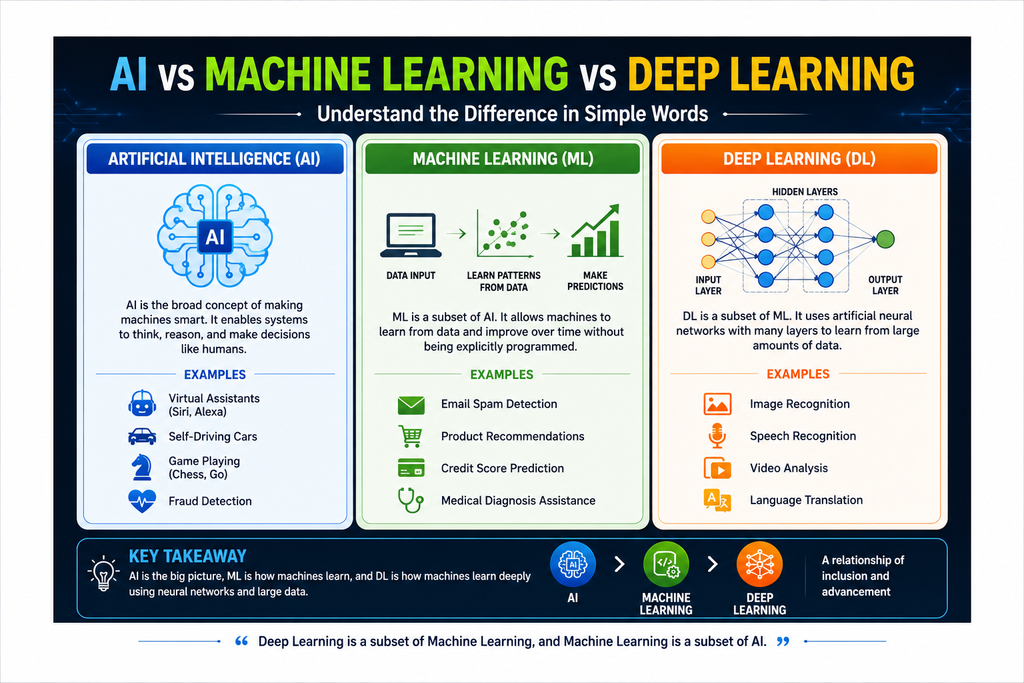
A useful way to visualize the relationship is:
Artificial Intelligence → Machine Learning → Deep Learning
Generative AI can use deep-learning architectures and other techniques depending on the application.
Understanding this distinction can make many AI articles and tutorials much easier to follow.
What Are the Main Steps in How AI Works?
Let’s summarize the entire process.
1. Collect Data
The system receives relevant examples or information.
2. Prepare the Data
Data may be cleaned, organized, labeled, transformed, or otherwise prepared.
3. Choose a Model
Developers select an appropriate machine-learning or AI approach.
4. Train the Model
The model learns patterns from the training data.
5. Evaluate the Model
Developers test its performance and identify weaknesses.
6. Deploy the Model
The trained model is integrated into an application or service.
7. Provide New Input
Users or other systems provide new information.
8. Generate an Output
The AI system uses its learned patterns to produce a prediction, classification, recommendation, or generated response.
9. Monitor and Improve
Developers can continue evaluating and improving the system as needed.
This is a simplified overview, but it provides a useful mental model for understanding how artificial intelligence works.
How does AI work.
Benefits of Understanding How AI Works

Understanding AI can help you recognize its many practical advantages. Read our guide to the [top benefits of Artificial Intelligence for beginners] for a deeper look at how AI can improve productivity and everyday tasks.
You don’t need to become an AI engineer to benefit from understanding the basics.
Better Use of AI Tools
Knowing how AI works can help you write better prompts and understand the strengths and limitations of AI tools.
Better Decision-Making
You can evaluate AI-generated information more critically.
Career Benefits
Basic AI literacy is becoming increasingly useful across many industries.
Improved Digital Skills
Understanding AI can help you adapt to new technologies.
Greater Awareness
You’ll be better equipped to understand conversations about AI, automation, privacy, bias, and the future of work.
How Can Beginners Start Learning AI?
If you’re ready to go beyond the basics, follow our [step-by-step beginner roadmap for learning AI] to build your AI skills from the ground up.
If you’re interested in learning more, you don’t need to start with advanced mathematics or programming.
A practical beginner roadmap is:
Step 1: Understand AI Fundamentals
Start with basic concepts such as:
- Artificial Intelligence
- Machine Learning
- Deep Learning
- Generative AI
- Neural Networks
Step 2: Use AI Tools
Experiment with beginner-friendly AI tools to understand what they can and cannot do.
Step 3: Learn Basic Prompting
Practice writing clear instructions and providing useful context.
Step 4: Explore Machine Learning
Once you understand the fundamentals, explore introductory machine-learning concepts.
Step 5: Learn Basic Python
If you want to move toward technical AI development, Python is a useful programming language to learn.
Step 6: Build Small Projects
Start with simple projects such as:
- Text classification
- Basic recommendation systems
- Image classification
- Simple chatbots
- Data analysis
The goal isn’t to learn everything at once. Build your knowledge gradually.
How does AI work.
Frequently Asked Questions About How AI Works
How does artificial intelligence work in simple terms?
AI works by processing information using algorithms and models that can identify patterns and produce predictions, decisions, recommendations, or generated content.
Does AI actually think like humans?
Not necessarily. Most AI systems process information using mathematical models and learned patterns rather than human-like consciousness or understanding.
Does AI learn by itself?
AI models can learn patterns from data during training, but humans design the systems, select training approaches, prepare data, evaluate performance, and deploy the resulting models.
What is the difference between AI and machine learning?
AI is the broader field, while machine learning is one approach used to create AI systems that learn patterns from data.
What is deep learning?
Deep learning is a type of machine learning that uses neural networks with multiple layers to learn complex patterns.
Can AI make mistakes?
Yes. AI systems can produce incorrect predictions or outputs. Generative AI can also generate plausible-sounding but inaccurate information.
Do I need programming knowledge to learn AI?
No. Beginners can first learn AI concepts and use AI tools without programming. Programming becomes more important if you want to build AI systems yourself.
Once you understand the fundamentals, the best way to build your confidence is to experiment with beginner-friendly tools. Check out our guide to the [best AI tools for beginners].
![[best AI tools for beginners]](https://nextgenaitoolnest.com/wp-content/uploads/2026/07/25-Best-AI-Tools-for-Beginners-in-2026_image.png)
How does AI work.
Conclusion: How Does Artificial Intelligence Work?
So, how does artificial intelligence work?
At its simplest, AI works by combining data, algorithms, models, and computing power to identify patterns and produce useful outputs.
Machine learning allows many AI systems to learn patterns from data. Neural networks and deep learning enable models to process increasingly complex information. Generative AI uses advanced models to create new content such as text, images, audio, and code.
The technology behind modern AI can be extremely complicated, but the basic idea doesn’t have to be.
Data provides information. Algorithms provide methods. Models learn patterns. AI uses those patterns to generate predictions, decisions, recommendations, or content.
Understanding these fundamentals is an excellent first step toward becoming more confident with AI.
If you’re new to the subject, continue your learning by exploring [What Is Artificial Intelligence? A Beginner’s Guide], [Types of Artificial Intelligence Explained for Beginners], and [AI vs Machine Learning vs Deep Learning].
How does AI work.
Call to Action
Hope you like our guide- How Does Artificial Intelligence Work?
If you’re just starting, don’t miss our first guide:
Blog 1: What is Artificial Intelligence? A Complete Beginner’s Guide
Follow NextGenAIToolNest for more AI guides, automation tips, and online earning strategies.
9 Comments