

 By
By Different types of AI.
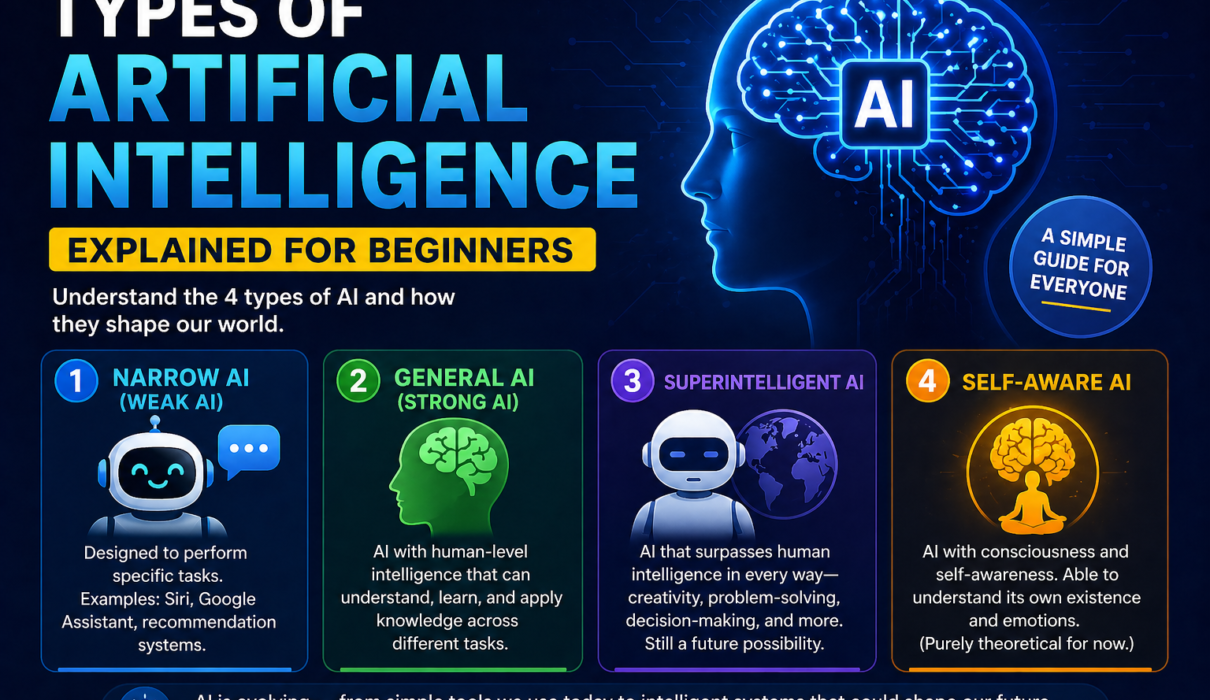
Types of Artificial Intelligence Explained for Beginners: The Complete Guide (2026)
Artificial Intelligence has rapidly moved from a futuristic concept to a technology we encounter every day. AI can recommend videos, translate languages, recognize faces, generate text and images, assist with coding, detect unusual financial transactions, and help businesses analyze large amounts of information.
But here’s an important question:
Are all AI systems the same?
No.
Artificial Intelligence can be classified in several different ways. Some classifications focus on how capable an AI system is, while others focus on how it operates and processes information.
Understanding these classifications makes it much easier to understand the AI tools and technologies you hear about today.
In this complete beginner’s guide, we’ll explain the types of Artificial Intelligence, their characteristics, examples, differences, limitations, and where they fit into the modern AI landscape.
Whether you’re a student, beginner, content creator, professional, or simply curious about technology, this guide will give you a clear foundation.
If you’re new to AI, start with our beginner-friendly guide on [How Does Artificial Intelligence Work? A Simple Explanation].
Different types of AI.
What Is Artificial Intelligence?
Before exploring the different types of AI, let’s quickly understand what Artificial Intelligence means.
Artificial Intelligence (AI) is a field of computer science focused on developing systems capable of performing tasks that typically require human-like intelligence.
These tasks can include:
- Understanding language
- Recognizing images
- Learning from data
- Identifying patterns
- Making predictions
- Solving problems
- Generating content
- Understanding speech
- Supporting decision-making
AI isn’t a single machine or program.
It is a broad field containing technologies such as:
- Machine learning
- Deep learning
- Natural language processing
- Computer vision
- Generative AI
- Robotics
If you’re completely new to AI, you can start with our guide to [How Does Artificial Intelligence Work? A Simple Explanation] to understand the basic process behind modern AI systems.
Different types of AI.
How Are Artificial Intelligence Systems Classified?
There isn’t just one way to classify AI.
Two commonly discussed classification systems are:
Classification by Capability
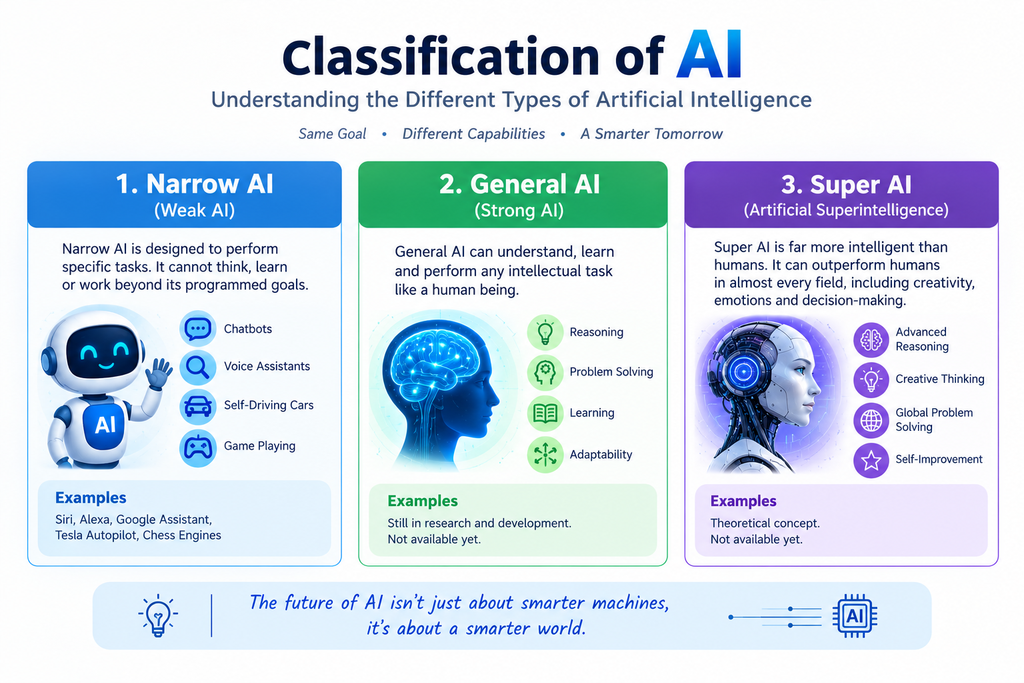
This approach considers how broadly capable an AI system is.
It includes:
- Artificial Narrow Intelligence (ANI)
- Artificial General Intelligence (AGI)
- Artificial Superintelligence (ASI)
Classification by Functionality
This approach considers how an AI system operates and handles information.
It includes:
- Reactive Machines
- Limited Memory
- Theory of Mind
- Self-Aware AI
These classifications are useful for learning, but they should not be confused with completely separate technologies. They are frameworks for describing AI systems from different perspectives.
Different types of AI.
Types of AI Based on Capability
Different types of AI.
Let’s start with the most commonly discussed classification.
1. Artificial Narrow Intelligence (ANI)
Artificial Narrow Intelligence (ANI) is AI designed to perform specific tasks or a limited range of tasks.
It is sometimes called:
- Narrow AI
- Weak AI
- Specialized AI
Despite the term “weak,” narrow AI can be extremely powerful at its designated task.
For example, an AI system designed to detect spam may be highly effective at identifying unwanted email.
But it cannot automatically become a doctor, write a legal contract, operate a factory, and teach mathematics unless it has been specifically designed and equipped for those tasks.
Examples of Narrow AI
Many AI systems available today fall into this category.
Examples include:
- Spam filters
- Recommendation systems
- Face-recognition systems
- Voice assistants
- Fraud detection systems
- AI translation tools
- Image-classification systems
- Navigation and route-prediction systems
- AI coding assistants
- Many generative AI applications
Even advanced AI tools can still be considered narrow AI if their capabilities remain bounded by their design and operating environment.
To explore practical applications, see our guide to [Artificial Intelligence in Daily Life].
Advantages of Narrow AI
Narrow AI can:
- Perform specific tasks efficiently
- Process large amounts of data
- Detect patterns quickly
- Automate repetitive work
- Provide consistent results
Limitations
The biggest limitation is specialization.
A system trained or designed for one task may not automatically possess the broad understanding needed for unrelated tasks.
Most practical AI applications today are examples of narrow or specialized AI.
For a broader overview of modern AI terminology and applications, see [IBM’s AI guide].
Types of AI.
2. Artificial General Intelligence (AGI)
Artificial General Intelligence (AGI) refers to a hypothetical form of AI that would possess broad, human-like intellectual capabilities across many different tasks.
Instead of being designed primarily for one particular problem, an AGI system would theoretically be able to:
- Learn new tasks
- Reason across different domains
- Understand unfamiliar problems
- Apply knowledge from one situation to another
- Adapt to new environments
- Solve a wide variety of intellectual problems
Imagine an AI that could learn mathematics, write software, study biology, plan a trip, learn a new language, and understand completely unfamiliar tasks without needing a separate specialized system for each activity.
That is closer to the concept of AGI.
Is AGI Here Yet?
There is significant debate about what exactly should count as AGI, and there is no universally accepted test or definition.
Modern AI systems can perform an impressive range of tasks, but that does not automatically mean they have achieved AGI.
Today’s AI systems can also have important limitations involving reliability, reasoning, planning, factual accuracy, physical-world interaction, and generalization.
Therefore, AGI remains a major research goal and subject of debate rather than a clearly established category of deployed AI.
Why Is AGI Important?
If developed successfully, AGI could potentially transform:
- Education
- Scientific research
- Healthcare
- Engineering
- Software development
- Business
- Robotics
However, developing highly capable general-purpose AI also raises important questions about safety, control, employment, privacy, security, and responsible development.
Types of AI
3. Artificial Superintelligence (ASI)
Artificial Superintelligence (ASI) is a hypothetical form of AI that would surpass human intelligence across virtually all intellectual areas.
It goes beyond AGI.
While AGI is generally imagined as having broad human-level capabilities, ASI would theoretically outperform humans in areas such as:
- Scientific reasoning
- Mathematics
- Strategic planning
- Creativity
- Problem-solving
- Learning
- Decision-making
ASI does not currently exist as a demonstrated real-world technology.
It is primarily discussed in future-oriented AI research, philosophy, science fiction, and debates about the long-term implications of advanced AI.
Why Do People Discuss ASI?
The possibility of extremely advanced AI raises questions such as:
- How would humans control such a system?
- What goals should it follow?
- How could its actions be made safe?
- Could it accelerate scientific discovery?
- How would society respond to major technological changes?
These are important questions, but they concern hypothetical future systems rather than a technology you can simply use today.
Different types of AI.
Types of AI Based on Functionality
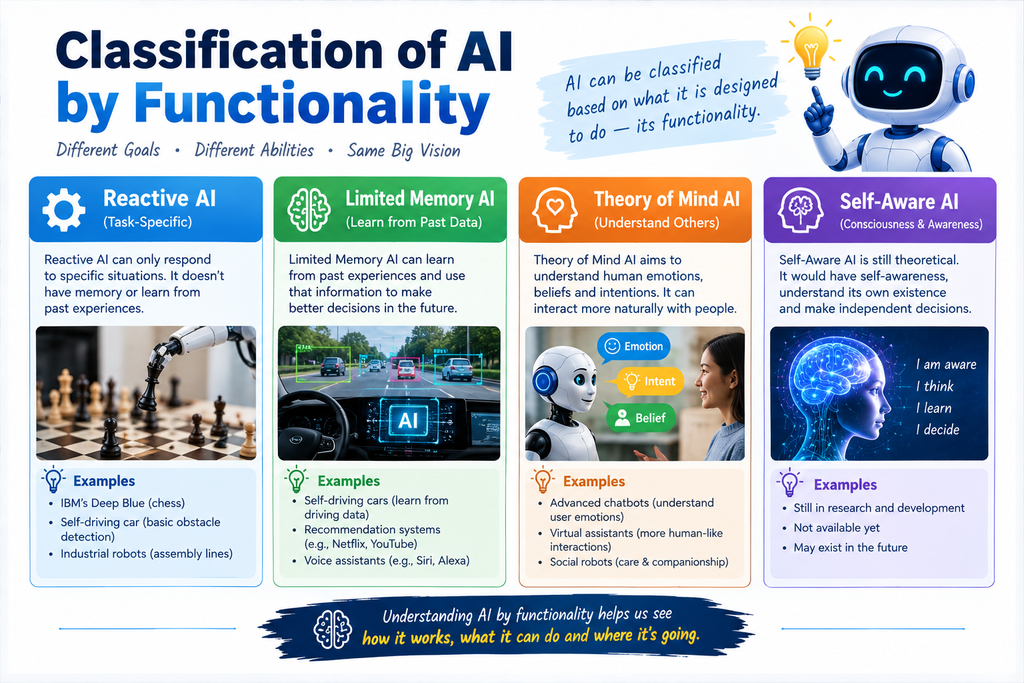
Types of Artificial Intelligence explained.
The second common classification looks at how AI systems operate.
This classification includes four categories.
Types of AI
4. Reactive Machines
Reactive machines are AI systems that respond to current inputs without maintaining a broader memory of previous experiences.
They don’t use a persistent understanding of past events in the way humans do.
A classic example often discussed in AI history is IBM’s Deep Blue, the chess-playing computer that defeated world champion Garry Kasparov in the 1990s.
Deep Blue could analyze chess positions and select moves, but it wasn’t learning about Kasparov’s personality or remembering previous games in the human sense.
Characteristics of Reactive AI
Reactive systems generally:
- Respond to current inputs
- Don’t maintain persistent memory
- Focus on predefined or computationally modeled tasks
- Have limited adaptability
Advantages
They can be:
- Fast
- Predictable
- Efficient
- Highly effective at specific tasks
Limitations
They have limited ability to use historical experience to improve decisions outside their designed framework.
Types of AI
5. Limited Memory AI
Limited Memory AI can use information from previous observations or stored data to make decisions.
This category is particularly important because many modern AI applications rely on information from past data.
For example, an AI system used in a vehicle may analyze information collected over time to help identify objects, road conditions, and driving situations.
Recommendation systems can also use historical user behavior to make predictions.
Examples
Limited-memory approaches can be found in:
- Recommendation systems
- Fraud detection
- Autonomous driving technologies
- Predictive systems
- Many machine-learning applications
How Does Limited Memory AI Work?
A simplified process might look like:
Historical Data → Training → Model → New Input → Prediction
The system uses information from past data to learn patterns and make predictions about new situations.
This is one of the major ideas behind modern machine learning.
For an accessible explanation of how machine learning systems learn patterns from data, see [IBM’s machine learning overview].
Types of AI
6. Theory of Mind AI
Theory of Mind AI refers to a hypothetical form of AI that would be capable of understanding human mental states.
This could include understanding:
- Emotions
- Beliefs
- Intentions
- Desires
- Expectations
- Social interactions
Humans naturally attempt to understand what other people are thinking and feeling.
For example, if someone says, “I’m fine,” while appearing upset, another person may recognize that the words and emotional state don’t necessarily match.
A true Theory of Mind AI would need sophisticated abilities to interpret such situations.
Does Theory of Mind AI Exist?
Not in the full sense described by this classification.
Modern AI can recognize certain emotional or linguistic patterns and can respond in ways that appear empathetic, but this shouldn’t be confused with possessing a human-like theory of mind.
Research into emotionally intelligent and socially aware AI continues to develop.
Types of AI
7. Self-Aware AI
Self-Aware AI is the most hypothetical category in this classification.
A self-aware AI would theoretically possess consciousness or an understanding of its own existence.
It might be able to understand:
- Its own internal state
- Its existence
- Its thoughts
- Its goals
- Its relationship with the external world
No scientifically established self-aware AI currently exists.
This concept is largely found in:
- Science fiction
- Philosophy
- Futurism
- Speculative AI discussions
It is important to distinguish sophisticated AI behavior from actual consciousness.
An AI system can generate convincing language about emotions or self-awareness without this proving that it actually experiences those things.
Types of AI
A Simple Table of the Types of AI
Different types of AI.
| Type | Basic Idea | Current Status |
|---|---|---|
| Narrow AI (ANI) | Performs specific tasks | Widely used |
| General AI (AGI) | Broad human-level intelligence | Not established |
| Super AI (ASI) | Surpasses human intelligence | Hypothetical |
| Reactive Machines | Respond to current inputs | Exists |
| Limited Memory | Uses historical information | Widely used |
| Theory of Mind | Understands mental states | Research/hypothetical |
| Self-Aware AI | Possesses self-awareness | Hypothetical |
Types of Artificial Intelligence explained.
This table provides a quick overview, but remember that the two classification systems describe AI from different perspectives.
Narrow AI vs General AI
One of the most important distinctions beginners should understand is the difference between Narrow AI and General AI.
| Feature | Narrow AI | General AI |
|---|---|---|
| Scope | Specific tasks | Broad range of tasks |
| Adaptability | Limited | Expected to be high |
| Human-like flexibility | Limited | Intended to be broad |
| Current availability | Common | Not established |
| Example | Spam detection | Hypothetical general-purpose intelligence |
A narrow AI system might be excellent at translating languages but unable to perform unrelated tasks.
AGI, by contrast, would theoretically be able to transfer knowledge across many different domains.
Types of Artificial Intelligence explained.
AI vs Machine Learning vs Deep Learning
Beginners often use these terms interchangeably, but they aren’t identical.
Artificial Intelligence
The broad field concerned with creating systems capable of intelligent behavior.
Machine Learning
A major approach within AI where systems learn patterns from data.
For a deeper introduction, see this [machine learning guide from IBM].
Deep Learning
A subset of machine learning that commonly uses multi-layer neural networks.
You can learn more about the relationship between these technologies in [IBM’s comparison of AI, machine learning, deep learning and neural networks].
You can visualize the relationship like this:
Artificial Intelligence
↓
Machine Learning
↓
Deep Learning
For a more detailed explanation, see our guide to [AI vs Machine Learning vs Deep Learning].
Where Does Generative AI Fit?
Generative AI is another term you’re likely to encounter.
For a deeper look at generative AI and its associated risks, see the [NIST Generative AI Risk Management Profile].
Generative AI refers to systems capable of generating new content such as:
- Text
- Images
- Audio
- Video
- Code
Examples include AI writing assistants, image generators, video-generation systems, and coding assistants.
Generative AI is not necessarily a separate “level” of intelligence like ANI, AGI, or ASI.
Instead, it describes a capability or approach focused on generating content.
Many current generative AI systems can be considered specialized or narrow AI, even though they can perform many different tasks.
If you’re interested in trying these technologies yourself, check out our list of [25 Best AI Tools for Beginners in 2026].
Are AI Chatbots Narrow AI?
This question can be confusing.
Modern AI chatbots can perform many tasks:
- Answer questions
- Summarize documents
- Generate content
- Translate text
- Write code
- Brainstorm ideas
- Analyze information
Because they appear versatile, people sometimes assume that they must be AGI.
However, versatility alone doesn’t establish AGI.
The classification depends on how intelligence, generalization, reasoning, learning, autonomy, and other capabilities are defined.
Therefore, it is more accurate to say that today’s advanced chatbots are highly capable AI systems with broad practical functionality, while the question of whether any current system qualifies as AGI remains debated.
Benefits of Understanding Different Types of AI
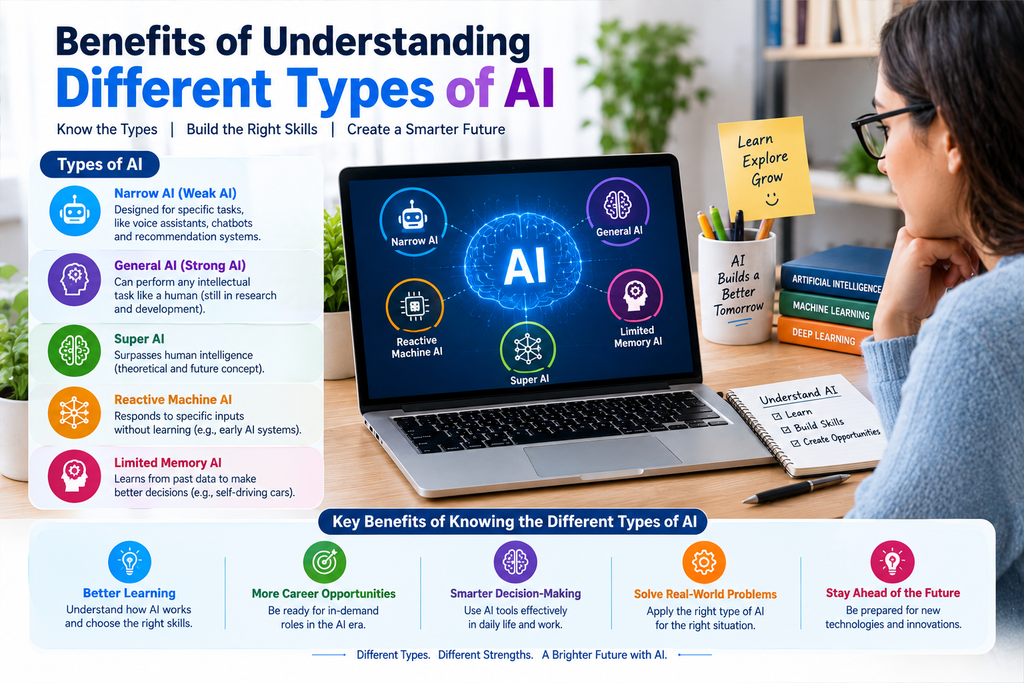
Why should a beginner learn these categories?
Because they help you understand AI discussions more clearly.
1. Better AI Literacy
You’ll understand what people mean when they discuss AGI, narrow AI, or generative AI.
2. Better Technology Decisions
Knowing what an AI system is designed to do helps you choose the right tool.
3. Better Understanding of AI Limitations
You can distinguish between a specialized tool and a hypothetical general intelligence.
4. Better Career Preparation
AI knowledge is becoming valuable across many industries.
5. More Responsible AI Use
Understanding what AI can and cannot do helps prevent unrealistic expectations.
You can also explore our guide to the [Ultimate Benefits of Artificial Intelligence] for a broader look at how AI is affecting modern life.
Common Misconceptions About AI Types
Myth 1: All AI Is Intelligent Like Humans
False.
Many AI systems are highly specialized.
Myth 2: Every Chatbot Is AGI
False.
A chatbot’s ability to handle multiple types of prompts doesn’t automatically prove general intelligence.
Myth 3: Super AI Already Exists
There is no established evidence that Artificial Superintelligence currently exists.
Myth 4: AI Has Human Consciousness
Sophisticated responses do not automatically demonstrate consciousness or self-awareness.
Myth 5: More Advanced AI Always Means AGI
Not necessarily.
An AI system can become substantially better at specific tasks without becoming generally intelligent.
For a deeper discussion, read [Common Myths About Artificial Intelligence (And the Truth)].
For a broader framework for thinking about trustworthy AI, see the [NIST AI Risk Management Framework].
The Future of Artificial Intelligence

The future of AI is difficult to predict.
AI capabilities are improving rapidly, particularly in areas such as:
- Language understanding
- Image generation
- Video generation
- Coding
- Scientific assistance
- Robotics
- Multimodal interaction
- AI agents
Researchers are also exploring systems that can perform increasingly complex sequences of tasks.
However, technological progress does not automatically mean that AGI or ASI has been achieved.
The future will depend on advances in algorithms, data, computing, robotics, safety research, and our understanding of intelligence itself.
There will also be important discussions around:
- AI safety
- Privacy
- Copyright
- Bias
- Employment
- Security
- Regulation
- Human oversight
Learning about AI today can help you participate more intelligently in these conversations tomorrow.
Different types of AI.
How Beginners Can Start Learning About AI
If you’re new to Artificial Intelligence, don’t try to learn everything at once.
Follow a simple progression.
Step 1: Learn the Fundamentals
Understand what AI means and how AI systems work.
Start with our [AI beginner’s guide].
Step 2: Learn Machine Learning
Understand:
- Training data
- Models
- Algorithms
- Predictions
- Neural networks
Step 3: Experiment With AI Tools
Try beginner-friendly AI tools for writing, research, images, productivity, and coding.
Our guide to [25 Best AI Tools for Beginners in 2026] is a useful starting point.
Step 4: Learn AI Skills
Once you’re comfortable with the basics, learn skills such as:
- Prompt writing
- Data analysis
- Basic programming
- Critical thinking
- AI ethics
Read our guide to [Skills You Need to Learn Artificial Intelligence].
Step 5: Keep Learning
AI changes quickly.
Follow reliable sources, experiment with new tools, and continue building your understanding.
Our collection of [Free Resources to Learn Artificial Intelligence] can help you continue your learning journey.
Different types of AI.
Frequently Asked Questions About Types of Artificial Intelligence
What are the main types of Artificial Intelligence?
AI is commonly classified by capability into Narrow AI, General AI, and Super AI. It can also be classified by functionality into Reactive Machines, Limited Memory, Theory of Mind, and Self-Aware AI.
Which type of AI is most common today?
Narrow AI is the most common form of AI used in practical applications today. Limited-memory approaches are also widely used in modern machine-learning systems.
Is ChatGPT Artificial General Intelligence?
Using the common classifications, modern chatbots should not automatically be considered AGI simply because they can perform many tasks. Whether any current system qualifies as AGI depends on the definition and criteria being used.
Does Artificial Superintelligence exist?
No established Artificial Superintelligence currently exists. ASI remains a hypothetical concept describing intelligence that would significantly surpass human intellectual abilities.
What is Narrow AI?
Narrow AI is designed to perform specific tasks or operate within a limited domain. Most practical AI applications today fall into this broad category.
What is Limited Memory AI?
Limited Memory AI uses information from previous observations or historical data to improve predictions or decisions.
What is Theory of Mind AI?
Theory of Mind AI refers to a hypothetical system capable of understanding human beliefs, intentions, emotions, and other mental states.
What is Self-Aware AI?
Self-Aware AI is a hypothetical form of AI that would possess genuine self-awareness or consciousness. No scientifically established self-aware AI currently exists.
Different types of AI.
Final Thoughts
Understanding the types of Artificial Intelligence is one of the best ways for beginners to build a strong foundation in AI.
The most commonly discussed categories are:
By capability:
- Artificial Narrow Intelligence
- Artificial General Intelligence
- Artificial Superintelligence
By functionality:
- Reactive Machines
- Limited Memory
- Theory of Mind
- Self-Aware AI
The important thing to remember is that these are different ways of classifying AI, rather than seven completely separate technologies.
Most AI systems you encounter today are specialized forms of AI. Machine learning and deep learning power many modern applications, while generative AI enables systems to create new text, images, audio, video, and code.
AGI, ASI, Theory of Mind AI, and Self-Aware AI involve concepts that remain subjects of research, debate, or speculation rather than established everyday technologies.
As AI continues to evolve, understanding these distinctions will help you separate real capabilities from exaggerated claims.
The best way to learn AI is to combine theory with practice. As you explore AI, it’s also worth understanding principles of trustworthy and responsible AI. The [NIST AI Risk Management Framework] is a useful starting point. Learn the basic concepts, experiment with AI tools, understand their limitations, and gradually explore more advanced topics.
Artificial Intelligence may seem complicated at first, but once you understand its major categories and how they relate to one another, the broader AI landscape becomes much easier to navigate.
Different types of AI.
Call to Action
Hope you liked our blog Types of Artificial Intelligence Explained for Beginners: The Complete Guide (2026).
For more related guides on Artificial Intelligence, follow us on NextGenAIToolNest.
6 Comments