
 By
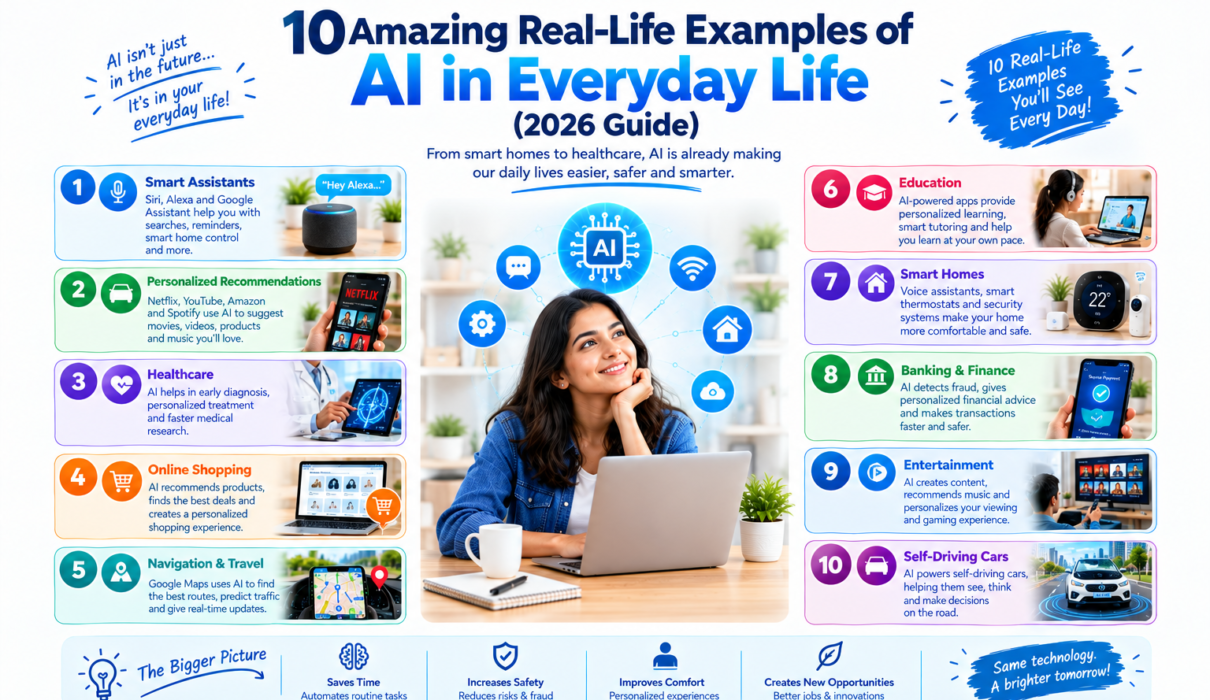
10 Real-Life Examples of AI You Use Every Day:-
Introduction–
Artificial Intelligence (AI) is no longer a futuristic concept seen only in movies. Today, AI is part of our daily routines, helping us communicate, shop, travel, learn, work, and entertain ourselves. Many people use AI-powered technologies every day without even realizing it.
From voice assistants and recommendation systems to smart cameras and navigation apps, AI has transformed the way we interact with technology. As AI continues to evolve, its presence in everyday life is becoming even more significant.
In this beginner-friendly guide, we’ll explore 10 amazing real-life examples of AI in everyday life, explain how they work, and understand why AI is becoming such an important part of modern living.
Uses of AI.
What Is AI in Everyday Life?
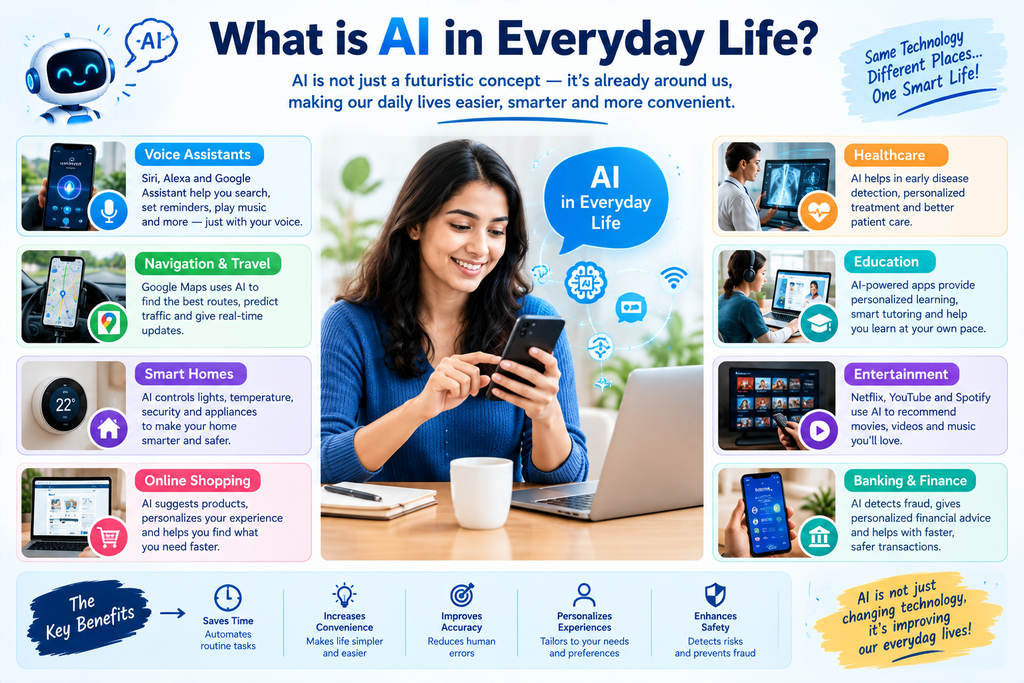
Artificial Intelligence refers to computer systems that can perform tasks associated with human intelligence, such as learning, problem-solving, pattern recognition, language understanding, and decision-making.
AI in everyday life means using these intelligent systems to make our daily activities easier, faster, and more personalized.
Examples include:
- Voice assistants
- Navigation apps
- Recommendation systems
- Smart cameras
- Chatbots
- Online shopping suggestions
- Email spam filters
- Smart home devices
If you use a smartphone, search engine, social media platform, or online shopping website, you are likely interacting with AI every day.
👉 If you’re new, start with Blog 1: What is AI to understand the basics.
1. Language Translation
AI translation tools helps people in the world to communicate easily as it is breaking down language issues. Here’s how language translation tools works:
- Tools: Google Translate, DeepL, Microsoft Translator
- Real-Time Translation: It translate text, speech and images helping in better communication across different languages.
- Contextual Accuracy: These tools adapt themselves by learning from new data and ensuring translations are more accurate.
- Global Communication: Enables seamless communication for business, travel and personal purposes in the world.
- Accessibility: Language translation tools have become necessary for travelers as it helps them to navigate foreign places easily.
Real-life examples of AI
ChatGPT by OpenAI
AI in daily life.
2. Voice Assistants
One of the most common real-life examples of AI in everyday life is voice assistants.
Popular voice assistants can:
- Answer questions
- Set reminders
- Play music
- Send messages
- Control smart devices
- Provide weather updates
AI enables these systems to understand spoken language, interpret requests, and generate responses.
How It Works
Voice assistants use:
- Speech recognition
- Natural Language Processing (NLP)
- Machine Learning
These technologies allow devices to understand what users say and provide relevant responses.
👉 Related: Learn how AI understands language in Blog 2: How AI Works
Voice assistants such as Alexa rely on AI technologies including speech recognition and natural language processing.
AI in daily life.
3. Education
AI is changing how students learn.
AI-powered tools can:
- Explain concepts
- Generate summaries
- Create quizzes
- Personalize learning
Students can use AI to:
- Learn faster
- Improve productivity
- Understand difficult topics
AI is becoming an important educational assistant for learners worldwide.
AI is changing education sector by offering personalized learning experiences and automating administrative tasks. Lets see how it helps students and teachers.
- Tools: Coursera, Google for Education, Duolingo, Quizlet
- Adaptive Learning: Platforms adjust content and lessons based on individual student performance and ensures personalized learning experiences.
- Automated Grading and Feedback: Saves time by checking assignments and offering instant feedback to students.
- Tutoring Assistance: It help students with one-on-one tutoring in the areas where they struggle.
- Classroom Insights: Teachers can analyze performance data to identify areas where students need extra help.
Real-life examples of AI
AI in daily life.
4. Autonomous Vehicles
Self-driving vehicles are changing the transportation system and also it plays a important role in the navigation and decision-making processes of these vehicles.
- Tools: Tesla Autopilot, Waymo, Uber ATG, Cruise
- Navigation and Decision-Making: Vehicles use sensors and algorithms to understand and find roads, detecting objects and obstacles.
- Safety Improvements: This technology helps in reducing accidents caused by human error which makes our travel more safer.
- Traffic Optimization: Autonomous cars communicate with each other to reduce traffic and improve fuel efficiency.
- Future of Transport: These vehicles are more efficient and accessible in the terms of transportation as they are including in delivery and public transport.
Companies like Tesla use AI to support advanced driver assistance and autonomous driving research.
AI in daily life.
5. Healthcare Diagnostics
It is helping doctors to diagnose diseases more quickly and accurately. Lets see how AI tools are used in medical diagnostics.
- Tools: Zebra Medical Vision, Aidoc, PathAI, Arterys
- Medical Imaging Analysis: They process medical images like X-rays and MRIs to detect diseases early.
- Personalized Treatment: Stores patient data and offers personalized treatment plans for our needs.
- Predicting Health Risks: Can predict future health risks by analyzing patterns in patient data.
- Efficiency: These tools increases the speed of diagnostics and reduces wait times and improving patient outcomes.
Real-life examples of AI
AI is helping doctors improve diagnoses and patient care. Mayo Clinic provides more information about AI in healthcare:
Read about AI in healthcare from Mayo Clinic.
6. Retail
In retail AI enhance customer experiences, manage inventory and personalize marketing efforts. Here’s how AI is transforming retail industry.
Customer Support: It handle common customer queries after providing 24/7 support.
Tools: Shopify, Magento, BigCommerce, Square
Product Recommendations: AI analyzes customer behavior and suggests products based on past purchases.
Dynamic Pricing: It adjusts prices in real-time, based on market trends and competitor analysis.
Inventory Management: AIso helps in tracking stock levels and manage restocking, improving operational efficiency.
Real-life examples of AI
7. Finance and Banking
AI plays an important role in making finance and banking services more efficient and secure. Lets see how AI tools are used in this sector.
- Tools: Robinhood, Mint, PayPal, Stripe
- Algorithmic Trading: These algorithms helps in analyzing market data and make real-time trading decisions.
- Fraud Detection: AI monitors financial transactions to detect suspicious activity and prevent fraud.
- Customer Service: Also chatbots answer customer questions and helps in assisting with transactions.
- Personalized Financial Advice: AI-driven platforms provide investment advices and helps individuals to manage their finances.
Real-life examples of AI
8. Smart Home Devices
Smart homes are becoming more popular due to AI.
Examples include:
- Smart lights
- Smart speakers
- Security cameras
- Smart thermostats
AI helps these devices:
- Learn user preferences
- Automate tasks
- Improve convenience
For example:
Smart lights can automatically adjust brightness based on time or activity.
Smart home devices using AI are becoming a common feature in our homes. These devices automate tasks and optimize energy use for enhanced convenience and security.
Personalized Control: Devices learn user preferences and adapt to improve over time.
Tools: Nest Thermostat, Philips Hue, Ring Security, Google Nest
Automation: Devices like thermostats and lights can adjust automatically based on user behavior.
Energy Efficiency: Using AI we can save electricity costs while maintaining comfort.
Home Security: AI-powered cameras and sensors detect unusual activity and send real-time alerts to homeowners.
Real-life examples of AI
9. Robotics
AI-powered robots are used in the industries like manufacturing, healthcare and agriculture. They helps in performing tasks easily and efficiently.
Exploration: They are used in environments that are hazardous for humans.
Tools: Boston Dynamics Spot, iRobot Roomba, DJI Tello, Kuka Robotics
Manufacturing: It can automate tasks which improves productivity and accuracy.
Healthcare: It helps with complex procedures, improves accuracy and reduces human error.
Agriculture: Robots in farming help with tasks like harvesting, planting and watering crops.
Real-life examples of AI
10. Gaming and Entertainment
AI is upgrading gaming and entertainment industry by creating more engaging, personalized experiences for users.
- Tools: Unity, Unreal Engine, Oculus VR, Steam
- Dynamic Gameplay: It can adjusts difficulty of games based on player performance also ensures an engaging experience.
- Content Generation: It helps in creating game levels, characters and storylines which helps in speeding up game development and offers variations.
- Smarter NPCs: It helps in making non-playable characters (NPCs) which behaves like a human and reacts to player actions in a natural way.
- Immersive Experiences: In virtual reality (VR) and augmented reality (AR), it adapts environments in real time to provide a better experience.
Real-life examples of AI
Artificial intelligence examples.
*The above described are the 10 Real-Life Examples of AI.
Benefits of AI in Everyday Life
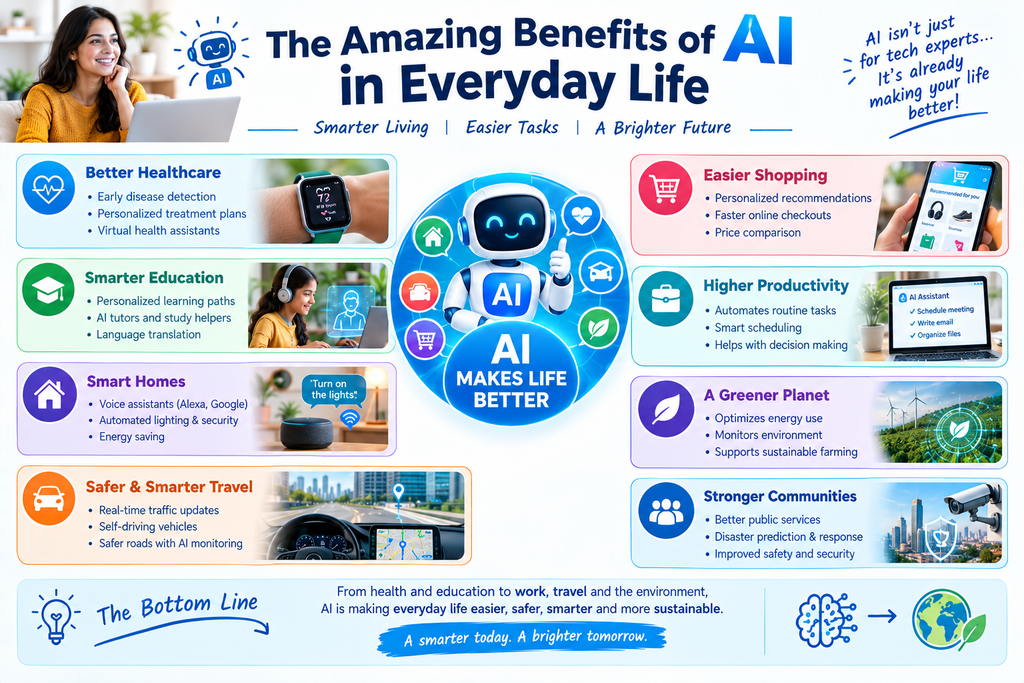
AI provides many advantages:
1. Saves Time
AI automates repetitive tasks.
2. Improves Productivity
AI helps people work faster.
3. Personalizes Experiences
AI recommends relevant content and products.
4. Enhances Convenience
AI simplifies everyday tasks.
5. Supports Better Decisions
AI analyzes information and identifies patterns.
Challenges of AI in Everyday Life
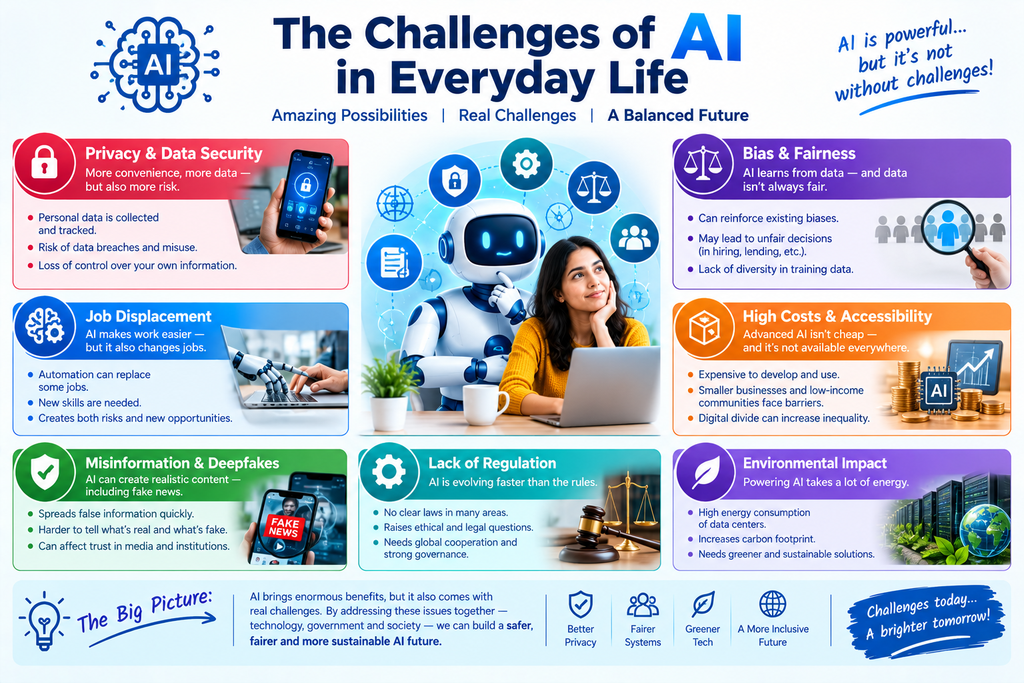
Although AI offers many benefits, there are also challenges.
Privacy Concerns
AI systems often rely on data.
Bias
Poor-quality data can affect AI results.
Misinformation
Generative AI may occasionally provide inaccurate information.
Dependence on Technology
Excessive dependence on AI can reduce critical thinking.
Responsible use of AI is important.
The Future of AI in Everyday Life
AI will continue transforming:
- Education
- Healthcare
- Business
- Transportation
- Entertainment
- Communication
Future AI systems may become more personalized, efficient, and useful.
As AI develops, understanding how it works will become an important skill.
Why Understanding Real-Life Examples of AI Matters
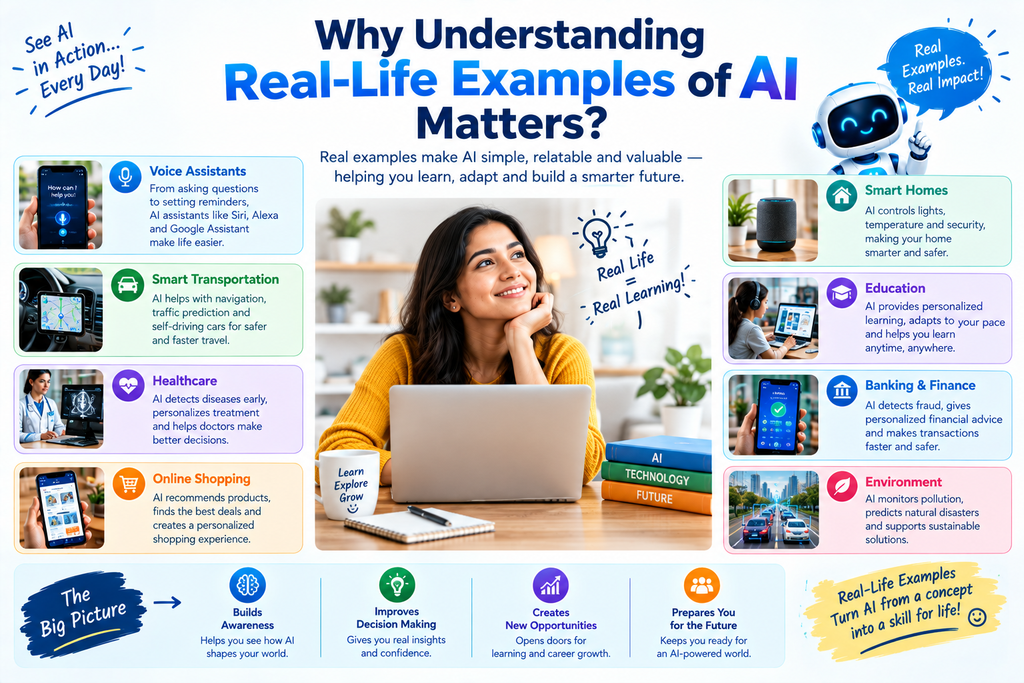
- Makes learning easier
- Builds confidence
- Shows real-world impact
👉 Next: Read Blog 6: Why AI is Important
Learn More About AI
If you’d like to explore Artificial Intelligence further, these trusted resources are excellent places to start:
- IBM AI Guide
https://www.ibm.com/think/topics/artificial-intelligence - Google AI
https://ai.google/ - Google Machine Learning
https://developers.google.com/machine-learning - Microsoft AI
https://www.microsoft.com/ai - OpenAI
https://openai.com/
Frequently Asked Questions
What are real-life examples of AI?
Examples include voice assistants, navigation apps, recommendation systems, smartphones, chatbots, and smart home devices.
Is AI used every day?
Yes. Most people use AI daily through smartphones, search engines, social media, maps, and online shopping.
What are the benefits of AI?
AI saves time, improves productivity, automates tasks, and personalizes experiences.
Can beginners understand AI?
Yes. Learning AI basics is easier when you start with real-world examples.
👉Learn- How to Start Learning AI Step-by-Step (Beginner Roadmap 2026)
AI applications.
Final Thoughts
Artificial Intelligence is already part of everyday life, even if we don’t always notice it. From voice assistants and navigation apps to recommendation systems and smart devices, AI is helping people save time, improve productivity, and make daily tasks easier.
Understanding these real-life examples of AI in everyday life is one of the best ways for beginners to learn how AI works. As AI continues to evolve, its impact on education, business, healthcare, and personal productivity will only grow.
The future is becoming increasingly AI-powered, and learning about AI today can help you better understand the technology shaping tomorrow.
Call to Action
If you’re just starting, don’t miss our previous blogs:
👉 Blog 3: Types of Artificial Intelligence Explained for Beginners
👉 Blog 4: AI vs Machine Learning vs Deep Learning – A Beginner-Friendly Guide
Follow NextGenAIToolNest for more AI guides, automation tips, and online earning strategies.
Real-life examples of AI
1 Comment