

 By
By Future of Artificial Intelligence – What to Expect
Artificial Intelligence (AI) is evolving faster than almost any other technology in history. What once seemed like science fiction is now becoming part of our everyday lives. From virtual assistants and AI-powered search engines to autonomous vehicles and intelligent healthcare systems, AI is transforming the way we live, work, and communicate.
The future of Artificial Intelligence promises even more exciting innovations. Experts predict that AI will become smarter, more personalized, and deeply integrated into nearly every industry. Businesses are investing billions of dollars in AI research, while governments and educational institutions are preparing people for an AI-driven future.
Whether you’re a student, a working professional, or simply curious about technology, understanding the future of AI can help you prepare for new opportunities and challenges.
In this guide, you’ll learn:
- What the future of Artificial Intelligence looks like
- Emerging AI technologies
- How AI will transform different industries
- AI career opportunities
- Potential risks and ethical concerns
- Skills you should learn today to stay future-ready
If you’re new to AI, start with our What Is Artificial Intelligence (AI)? – Beginner’s Guide before continuing.
Table of Contents
- What Is the Future of Artificial Intelligence?
- Why AI Is Growing So Quickly
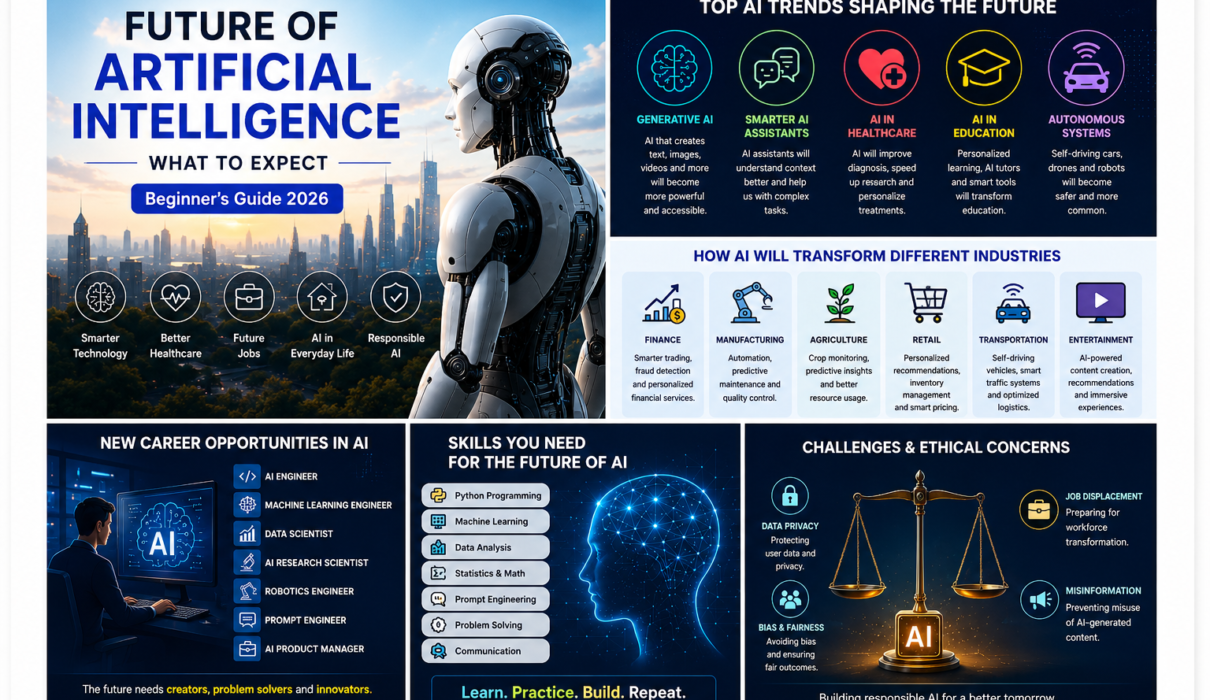
- Top AI Trends Shaping the Future
- Future of AI in Different Industries
- Will AI Replace Human Jobs?
- AI Skills You’ll Need
- Ethical Challenges of AI
- Frequently Asked Questions
- Final Thoughts
What Is the Future of Artificial Intelligence?
The future of Artificial Intelligence refers to how AI technologies are expected to develop over the coming years and how they will influence society, businesses, education, healthcare, transportation, entertainment, and many other sectors.
Rather than replacing every human task, AI is expected to work alongside people by:
- Automating repetitive tasks
- Improving decision-making
- Increasing productivity
- Personalizing customer experiences
- Accelerating scientific research
- Assisting professionals with complex problem-solving
In the next decade, AI will likely become as common as smartphones and the internet are today.
Why Is Artificial Intelligence Growing So Fast?
Several factors are driving rapid AI growth.
1. More Powerful Computers
Modern GPUs and cloud computing platforms can process enormous amounts of data much faster than traditional computers. This enables researchers to train advanced AI models in days instead of months.
2. Massive Amounts of Data
Every day, billions of people generate data through smartphones, websites, social media, online shopping, and connected devices.
AI systems learn from this data, becoming more accurate over time.
3. Better AI Algorithms
Researchers continue to improve machine learning algorithms, neural networks, and large language models.
These improvements make AI:
- Faster
- More reliable
- More accurate
- Better at understanding human language
4. Increased Business Investment
Companies around the world are investing heavily in AI to improve efficiency, reduce costs, and create new products.
Industries such as healthcare, finance, education, manufacturing, and retail are rapidly adopting AI-powered solutions.
Top AI Trends Shaping the Future
Understanding current trends provides insight into where AI is headed.
1. Generative AI Will Continue to Grow
Generative AI tools like ChatGPT, image generators, and AI coding assistants have already changed how people create content and solve problems.
In the future, Generative AI is expected to:
- Create videos
- Design websites
- Develop software
- Generate realistic simulations
- Assist with scientific discoveries
Businesses will increasingly integrate these tools into everyday workflows.
Related Article: What Is ChatGPT and How Does It Work?
2. AI Assistants Will Become Smarter
Today’s virtual assistants can answer questions and perform basic tasks.
Future AI assistants may:
- Understand complex conversations
- Manage schedules automatically
- Book travel arrangements
- Analyze documents
- Write reports
- Collaborate with multiple AI systems
These assistants will become valuable personal and professional productivity tools.
3. AI in Healthcare
Healthcare is expected to experience one of the biggest transformations.
Future AI applications may include:
- Early disease detection
- Personalized treatment plans
- Drug discovery
- Medical imaging analysis
- Virtual health assistants
- Predictive patient monitoring
Doctors will likely use AI as a decision-support tool rather than a replacement for medical expertise.
4. AI in Education
Education is becoming increasingly personalized through AI.
Future classrooms may include:
- AI tutors available 24/7
- Personalized learning paths
- Automated grading
- Real-time language translation
- Interactive virtual classrooms
Students will receive learning experiences tailored to their strengths and weaknesses.
Related Article: Artificial Intelligence (AI) in Daily Life – A Complete Guide
5. AI in Transportation
Autonomous vehicles continue to improve.
Over the next decade, we may see:
- Safer self-driving technology
- Smarter traffic management
- AI-powered logistics
- Autonomous delivery robots
- Intelligent navigation systems
Although fully autonomous transportation may take time to become widespread, AI will continue improving safety and efficiency.
6. AI in Business
Organizations are using AI to automate repetitive tasks and make better decisions.
Future business applications include:
- Customer support automation
- Demand forecasting
- Fraud detection
- Marketing personalization
- Sales prediction
- Business intelligence
Companies adopting AI effectively may gain significant competitive advantages.
How AI Will Transform Everyday Life
Many people already interact with AI without realizing it.
In the future, AI may become even more integrated into daily routines.
Examples include:
- Smart homes adjusting lighting and temperature automatically
- AI-powered shopping recommendations
- Personalized fitness coaching
- Financial planning assistants
- AI travel planners
- Real-time language translation during conversations
- Smarter search engines
- Personalized entertainment recommendations
Instead of replacing daily life, AI is expected to make many routine tasks more convenient and efficient.
Will Artificial Intelligence Become More Human-Like?
One of the most discussed questions is whether AI will eventually think like humans.
Current AI systems are excellent at recognizing patterns, generating text, analyzing data, and completing specific tasks. However, they do not possess human consciousness, emotions, or self-awareness.
Researchers continue exploring advanced AI capabilities, but there is no consensus on whether machines will ever achieve human-like general intelligence.
For the foreseeable future, AI is best understood as a powerful tool that complements human abilities rather than replacing human intelligence entirely.
Future of Artificial Intelligence in Different Industries
Artificial Intelligence is already transforming many industries, and its influence will continue to expand over the next decade. Let’s explore how AI is expected to shape different sectors.
1. Future of AI in Finance
The financial industry has been one of the earliest adopters of AI.
In the coming years, AI is expected to improve:
- Fraud detection
- Credit risk analysis
- Personalized financial advice
- Algorithmic trading
- Customer service through AI chatbots
- Expense tracking and budgeting
Banks will likely use AI to detect suspicious transactions in real time, making digital payments more secure.
2. Future of AI in Manufacturing
Factories are becoming smarter through AI-powered automation.
Future applications include:
- Predictive equipment maintenance
- Automated quality control
- Intelligent supply chain management
- Collaborative robots (cobots)
- Inventory optimization
These advancements can reduce downtime, improve efficiency, and lower production costs.
3. Future of AI in Agriculture
Agriculture is also benefiting from AI innovations.
Farmers are beginning to use AI for:
- Crop health monitoring
- Weather forecasting
- Precision irrigation
- Pest detection
- Soil analysis
- Automated harvesting
These technologies can increase crop yields while reducing waste and resource consumption.
4. Future of AI in Retail
Shopping experiences are becoming increasingly personalized.
Future retail innovations may include:
- AI-powered virtual shopping assistants
- Personalized product recommendations
- Smart inventory management
- Automated checkout systems
- Dynamic pricing based on demand
Customers can expect faster, more convenient shopping experiences both online and in physical stores.
5. Future of AI in Entertainment
The entertainment industry is rapidly embracing AI.
Future applications include:
- Personalized movie and music recommendations
- AI-assisted video editing
- Content generation
- Game development
- Virtual influencers
- Interactive storytelling
Rather than replacing creativity, AI is likely to become a powerful tool for creators, helping them produce content more efficiently.
6. Future of AI in Cybersecurity
As cyber threats become more sophisticated, AI will play an increasingly important role in digital security.
AI systems can:
- Detect unusual network activity
- Identify malware
- Predict cyberattacks
- Automate incident response
- Reduce response times
Organizations are expected to rely heavily on AI to strengthen cybersecurity defenses.
Imerging AI Technologies to Watch
The future of Artificial Intelligence isn’t limited to today’s tools. Several emerging technologies are expected to redefine what’s possible.
AI Agents
AI agents are intelligent systems capable of planning, reasoning, and completing multi-step tasks with minimal human input.
Examples include:
- Research assistants
- Customer service agents
- Scheduling assistants
- Coding assistants
- Workflow automation tools
As these systems improve, they may handle increasingly complex responsibilities across many industries.
Robotics and AI
Combining robotics with Artificial Intelligence enables machines to interact with the physical world.
Future AI-powered robots may assist in:
- Healthcare
- Warehousing
- Disaster response
- Manufacturing
- Space exploration
- Home assistance
These robots will become more adaptable and capable of working safely alongside people.
Edge AI
Instead of sending data to distant cloud servers, Edge AI processes information directly on devices such as smartphones, cameras, and IoT sensors.
Benefits include:
- Faster decision-making
- Improved privacy
- Lower latency
- Reduced internet dependence
Edge AI is expected to power smart homes, autonomous vehicles, and industrial automation.
Quantum AI
Although still in its early stages, Quantum AI combines quantum computing with Artificial Intelligence.
Potential future applications include:
- Drug discovery
- Climate modeling
- Financial optimization
- Complex scientific simulations
While widespread adoption may take years, Quantum AI remains an exciting area of research.
Will Artificial Intelligence Replace Human Jobs?
This is one of the most common questions people ask about the future of AI.
The answer is not simply yes or no.
AI will likely automate many repetitive and predictable tasks, but it will also create new roles and transform existing ones.
Jobs that involve repetitive processes—such as data entry or routine administrative work—may become more automated. However, roles requiring creativity, empathy, strategic thinking, leadership, and complex decision-making are expected to continue relying heavily on human expertise.
Rather than replacing all workers, AI is more likely to change how people work, enabling them to focus on higher-value activities.
Related Article : AI and Jobs – Will Artificial Intelligence Replace Humans?
New Career Opportunities Created by AI
As AI adoption grows, demand for skilled professionals is increasing.
Some of the fastest-growing AI-related careers include:
AI Engineer
Designs and develops AI-powered applications.
Machine Learning Engineer
Builds systems that learn from data and improve over time.
Data Scientist
Analyzes data to generate insights and support decision-making.
Prompt Engineer
Designs effective prompts to help Generative AI systems produce better results.
AI Research Scientist
Develops new AI algorithms and contributes to advancing the field.
Robotics Engineer
Combines Artificial Intelligence with robotics to build intelligent machines.
AI Product Manager
Leads the development of AI-powered products by coordinating technical and business teams.
Skills You’ll Need for the Future of AI
To stay competitive in an AI-driven world, beginners should focus on building both technical and non-technical skills.
Technical Skills
- Python programming
- Machine Learning fundamentals
- Data analysis
- Statistics
- Prompt Engineering
- Cloud computing basics
- Git and GitHub
- API integration
Soft Skills
Technical knowledge alone isn’t enough.
Future professionals will also benefit from:
- Critical thinking
- Creativity
- Communication
- Collaboration
- Adaptability
- Ethical decision-making
- Continuous learning
The combination of AI literacy and strong human skills will become increasingly valuable.
Related Article : Skills You Need to Learn Artificial Intelligence
Challenges and Ethical Concerns
While the future of Artificial Intelligence is promising, several important challenges remain.
Bias in AI Systems
AI models can produce unfair outcomes if they are trained on biased or unrepresentative data.
Developers must work to improve fairness and transparency.
Privacy and Data Security
AI often relies on large amounts of data.
Protecting personal information and ensuring responsible data use will remain a major priority.
Misinformation
Generative AI can create realistic text, images, audio, and videos.
Responsible use and effective verification methods will be essential to combat misinformation.
Regulation and Governance
Governments around the world are developing policies to encourage innovation while protecting public safety and individual rights.
Responsible AI development will require collaboration among researchers, businesses, policymakers, and society.
Related Article (Internal Link): Ethical Concerns in Artificial Intelligence – Beginner’s Guide
How to Prepare for an AI-Driven Future
You don’t need to become an AI engineer to benefit from Artificial Intelligence.
Here are some practical steps:
- Learn the fundamentals of AI.
- Practice using popular AI tools.
- Improve your digital and data literacy.
- Learn basic Python programming.
- Stay informed about new AI developments.
- Build small projects to apply your knowledge.
- Develop problem-solving and communication skills.
- Embrace lifelong learning.
Those who adapt and continue learning will be better positioned to take advantage of the opportunities AI creates.
Expert Predictions: What Will AI Look Like in the Next 10 Years?
While no one can predict the future with complete certainty, researchers, technology companies, and industry leaders agree that Artificial Intelligence will continue to evolve rapidly. Here are some trends that are likely to shape the next decade.
1. AI Will Become More Personalized
Future AI systems will better understand user preferences, habits, and goals. Instead of offering generic responses, AI assistants may provide highly personalized recommendations for learning, shopping, healthcare, entertainment, and productivity.
2. AI Will Work Alongside Humans
Rather than replacing people entirely, AI is expected to become a collaborative partner.
Professionals may use AI to:
- Draft reports
- Analyze complex datasets
- Generate ideas
- Automate repetitive tasks
- Improve decision-making
Human creativity, empathy, leadership, and ethical judgment will remain essential.
3. Smarter AI-Powered Devices
Everyday devices are becoming increasingly intelligent.
Future examples include:
- Smart home assistants that anticipate your needs
- AI-powered wearable health monitors
- Intelligent vehicles with advanced driver assistance
- Smart factories with autonomous robots
- Personalized educational devices
4. Faster Scientific Discoveries
AI is already helping researchers analyze massive datasets, simulate experiments, and identify patterns that would be difficult for humans to detect.
In the coming years, AI may accelerate discoveries in:
- Medicine
- Climate science
- Renewable energy
- Space exploration
- Materials science
5. Responsible AI Will Become a Priority
As AI becomes more powerful, organizations will place greater emphasis on:
- Transparency
- Fairness
- Privacy
- Accountability
- Security
Responsible AI practices will help build public trust while encouraging innovation.
Benefits of the Future of Artificial Intelligence
The future of Artificial Intelligence has the potential to improve many aspects of daily life.
Some key benefits include:
Increased Productivity
AI can automate repetitive tasks, allowing individuals and businesses to focus on more creative and strategic work.
Better Healthcare
AI may support earlier diagnoses, personalized treatment plans, and faster medical research.
Improved Education
Students could benefit from personalized learning experiences, AI tutors, and instant feedback.
Smarter Businesses
Organizations may use AI to optimize operations, improve customer service, and make better data-driven decisions.
Enhanced Accessibility
AI-powered speech recognition, translation, image descriptions, and assistive technologies can make digital services more accessible to people with disabilities.
Frequently Asked Questions (FAQs)
Is Artificial Intelligence the future?
Yes. Artificial Intelligence is expected to play an increasingly important role across industries, helping people automate tasks, solve complex problems, and improve productivity.
Will AI replace all jobs?
No. While AI will automate some repetitive tasks, it is also expected to create new career opportunities and transform existing roles. Many jobs will increasingly combine human expertise with AI tools.
Which industries will benefit most from AI?
Some of the industries expected to benefit significantly include:
- Healthcare
- Finance
- Education
- Manufacturing
- Agriculture
- Retail
- Transportation
- Cybersecurity
- Entertainment
What skills should beginners learn?
If you’re preparing for the future of Artificial Intelligence, focus on:
- Python programming
- AI fundamentals
- Machine Learning
- Prompt Engineering
- Data analysis
- Critical thinking
- Communication
- Problem-solving
Can beginners learn AI?
Absolutely. There are many beginner-friendly resources, courses, and tools available online that make learning AI accessible, even without prior programming experience.
Suggested Internal Link: Free Resources to Learn Artificial Intelligence
Is AI safe?
AI can provide enormous benefits when developed and used responsibly. Ensuring fairness, privacy, transparency, and security will remain important as AI adoption grows.
How can I start learning AI today?
A simple roadmap is:
- Learn Python basics.
- Understand AI concepts.
- Study Machine Learning fundamentals.
- Practice using AI tools.
- Build beginner projects.
- Continue learning through hands-on experience.
Final Thoughts
The future of Artificial Intelligence is full of exciting possibilities. From smarter healthcare and personalized education to intelligent business solutions and scientific breakthroughs, AI has the potential to improve many aspects of our lives.
At the same time, AI also presents important challenges related to privacy, ethics, fairness, and workforce transformation. Addressing these issues responsibly will be just as important as advancing the technology itself.
For beginners, the best approach is to start learning today. Build a strong foundation, practice with AI tools, create projects, and stay curious about new developments. The AI landscape is evolving rapidly, and those who embrace continuous learning will be well positioned to benefit from future opportunities.
Artificial Intelligence isn’t just shaping the future—it’s already influencing the present. By understanding where AI is heading and developing relevant skills now, you’ll be better prepared for the exciting changes ahead.
Recommended Authoritative External Links
Below are some external sources to deeply understand the future of artificial intelligence:-
- Google AI — https://ai.google
- OpenAI — https://openai.com
- Microsoft Learn — https://learn.microsoft.com/training/
- IBM Artificial Intelligence — https://www.ibm.com/artificial-intelligence
- NVIDIA AI — https://www.nvidia.com/en-us/ai-data-science/
- DeepLearning.AI — https://www.deeplearning.ai
- Hugging Face Learn — https://huggingface.co/learn
Call to Action
The future of AI is unfolding every day, and there has never been a better time to start learning.
If you’re just beginning your journey, explore our beginner-friendly guides on Artificial Intelligence, ChatGPT, AI tools, and free AI learning resources to build a strong foundation and stay ahead in the age of AI.
Follow us on NextGenAIToolNest to get more updates on Artificial Intelligence.