

 By
Artificial Intelligence (AI), Machine Learning (ML), and Deep Learning (DL) are three of the most important technologies shaping the modern digital world. You may hear these terms in discussions about ChatGPT, self-driving cars, recommendation systems, facial recognition, smart assistants, and other advanced technologies.
But are AI, Machine Learning, and Deep Learning the same thing?
Not exactly.
The terms are closely connected, but they describe different levels of technology. Artificial Intelligence is the broadest concept, Machine Learning is a subset of AI, and Deep Learning is a specialized subset of Machine Learning. IBM similarly describes AI as the overarching field, with ML inside AI and deep learning inside ML. (IBM)
Understanding the difference between AI vs Machine Learning vs Deep Learning is important for anyone who wants to learn AI, choose AI tools, understand modern technology, or prepare for an AI-powered future.
In this guide, we will explain AI, Machine Learning, and Deep Learning in simple language, compare their differences, explore real-world examples, and show how they work together.
AI vs Machine Learning vs Deep Learning: The Quick Answer
The easiest way to understand the relationship is:
Artificial Intelligence → Machine Learning → Deep Learning
Think of them as nested concepts.
- Artificial Intelligence (AI): The broad field of creating machines or computer systems that can perform tasks associated with human intelligence.
- Machine Learning (ML): A subset of AI in which systems learn patterns from data and use those patterns to make predictions or decisions.
- Deep Learning (DL): A subset of Machine Learning that uses multilayer neural networks to learn complex patterns from large amounts of data.
So, all deep learning is machine learning, and most machine learning is considered AI—but not all AI uses machine learning or deep learning. (IBM)
AI vs Machine Learning vs Deep Learning
What Is Artificial Intelligence?
what is artificial intelligence?
Artificial Intelligence, commonly called AI, is the broadest term among the three.
AI refers to technologies that enable computers and machines to perform tasks that normally require aspects of human intelligence, such as understanding language, recognizing objects, solving problems, making predictions, generating content, or supporting decisions. (IBM)
In simple words:
AI is the goal of making machines capable of performing intelligent tasks.
AI does not necessarily have to learn from data. Some AI systems can operate using predefined rules and instructions.
Examples of AI
Some common examples include:
- Virtual assistants
- Chatbots
- Recommendation systems
- Fraud detection systems
- Computer vision applications
- Speech recognition
- Navigation systems
- AI-powered search
- Generative AI tools
- Automated decision-support systems
For example, imagine a simple system that recommends an action whenever a specific condition occurs:
If temperature exceeds a certain level → turn on the cooling system.
This can be considered an AI-style rule-based system even though it may not learn from experience.
Modern AI, however, increasingly relies on Machine Learning and Deep Learning.
AI Is a Broad Umbrella
One of the biggest misconceptions about AI is that every AI system works like ChatGPT.
That is not true.
AI includes many different techniques, from traditional rule-based systems to sophisticated machine-learning and deep-learning models.
This is why it is useful to think of AI as the umbrella term.
Learn- “what Artificial Intelligence actually is.”
What Is Machine Learning?
Machine Learning is a subset of Artificial Intelligence.
Instead of programming every possible instruction manually, Machine Learning allows a computer system to learn patterns from data and use those patterns to make predictions or decisions about new information. (IBM)
In simple terms:
Machine Learning allows computers to learn from data rather than relying entirely on explicitly programmed rules.
For example, suppose you want to create a system that identifies spam emails.
With traditional programming, you might manually create rules such as:
- If an email contains certain words, mark it as spam.
- If the sender is unknown, increase the spam score.
- If the email contains suspicious links, flag it.
With Machine Learning, you could provide the system with many examples of emails labeled “spam” and “not spam.”
The model can then learn patterns associated with spam and use those patterns to classify new emails.
How Machine Learning Works
A simplified Machine Learning process looks like this:
Data → Training → Model → Prediction → Evaluation
First, data is collected.
Next, the Machine Learning algorithm analyzes the training data and learns patterns.
The resulting model can then process new data and produce predictions or classifications.
For example:
Customer data → ML model → predicted customer behavior
Machine Learning is used for tasks such as:
- Fraud detection
- Product recommendations
- Customer segmentation
- Demand forecasting
- Spam detection
- Credit risk analysis
- Predictive maintenance
- Search ranking
Google provides beginner-oriented Machine Learning resources covering fundamentals, problem framing, recommendation systems, clustering, and other ML concepts. (Google for Developers)
What Is Deep Learning?
Deep Learning is a specialized subset of Machine Learning.
It uses multilayer artificial neural networks to learn increasingly complex patterns from data. (IBM)
In simple terms:
Deep Learning is a type of Machine Learning that uses deep neural networks to process complex information.
The word “deep” refers to the multiple layers within the neural network.
A simplified neural network can contain:
Input Layer → Hidden Layers → Output Layer
Each layer processes information and passes it to the next layer.
Modern deep-learning systems can work particularly well with complex and unstructured data such as:
- Images
- Audio
- Video
- Text
- Speech
- Natural language
Deep Learning has become particularly important in areas such as computer vision, speech recognition, natural language processing, robotics, and generative AI. (IBM)
AI vs Machine Learning vs Deep Learning: Simple Comparison
Here is a quick comparison:
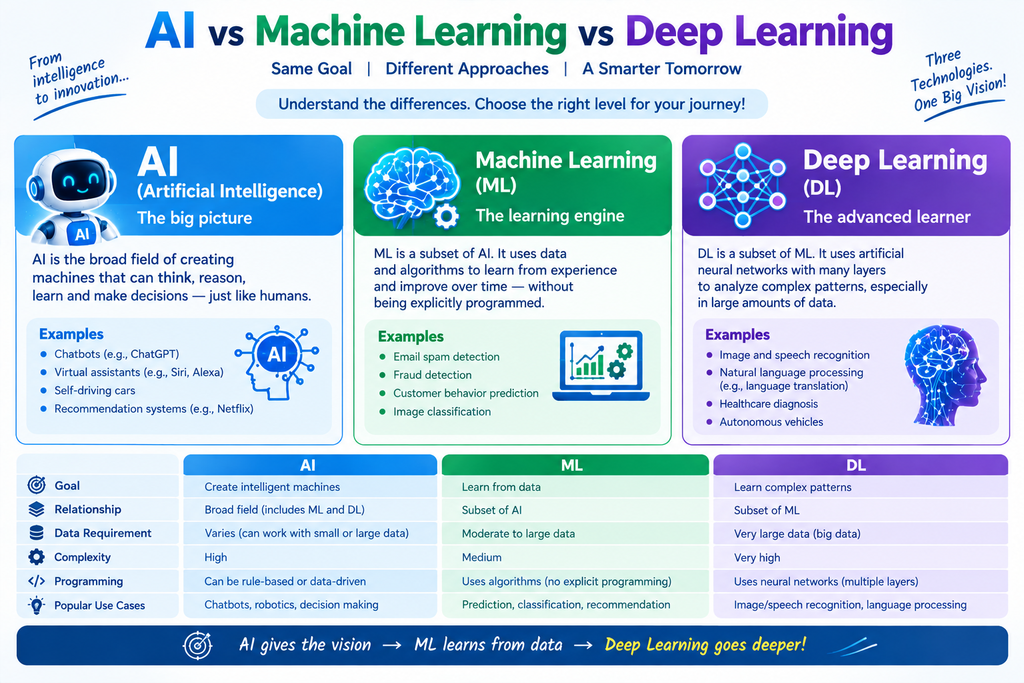
AI vs Machine Learning vs Deep Learning.
| Feature | Artificial Intelligence | Machine Learning | Deep Learning |
|---|---|---|---|
| Meaning | Broad field of intelligent machines | Subset of AI that learns from data | Subset of ML using deep neural networks |
| Main goal | Simulate or perform intelligent tasks | Learn patterns and make predictions | Learn complex patterns automatically |
| Requires learning from data? | Not always | Usually | Yes |
| Human involvement | Can be high | Moderate | Often lower for feature extraction |
| Data requirements | Varies | Moderate to large | Usually large |
| Typical techniques | Rules, search, ML, reasoning | Decision trees, regression, clustering, etc. | Neural networks |
| Complexity | Broad | More specialized | Generally more computationally intensive |
| Examples | Expert systems, AI assistants | Spam filters, recommendations | Image recognition, speech AI, LLMs |
AI vs Machine Learning vs Deep Learning.
The important point is that these are not competing technologies. They are related layers of the same broader technological landscape.
The Relationship Between AI, ML, and Deep Learning
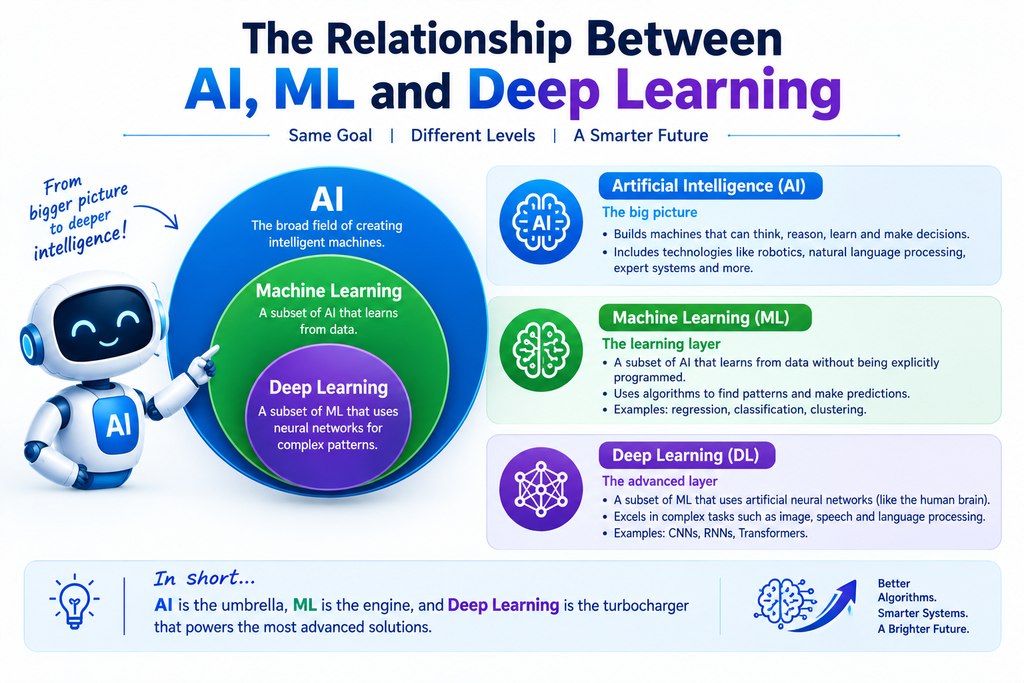
AI vs Machine Learning vs Deep Learning.
Imagine a large circle labeled Artificial Intelligence.
Inside it is a smaller circle called Machine Learning.
Inside Machine Learning is another circle called Deep Learning.
This gives us:
AI
↳ Machine Learning
↳ Deep Learning
This relationship is one of the most important concepts for beginners to understand.
Deep Learning does not replace AI.
Instead, Deep Learning is one of the techniques used within Machine Learning, which itself belongs to the larger field of AI.
AI vs Machine Learning: What Is the Difference?
The main difference is scope.
AI is the broader concept, while Machine Learning is one approach used to achieve AI-related capabilities.
AI focuses on creating systems capable of intelligent behavior.
Machine Learning focuses on creating systems that learn patterns from data.
Example
Imagine a recommendation system on an online shopping website.
The overall recommendation application could be considered an AI system.
The algorithm analyzing previous customer behavior and predicting products a customer might like could use Machine Learning.
So:
AI = intelligent system
ML = learning mechanism
This distinction helps explain why the two terms are often used interchangeably even though they are not technically identical.
AI vs Machine Learning
Machine Learning vs Deep Learning: What Is the Difference?
The biggest difference is how the systems learn from data.
Traditional Machine Learning often requires humans to select or engineer useful features from the data.
Deep Learning can automatically learn useful representations from raw or relatively unstructured data through multiple layers of neural networks. IBM notes that deep learning automates much of the feature-extraction process compared with traditional machine-learning approaches. (IBM)
machine learning vs deep learning.
Simple Example: Recognizing a Cat
Suppose you want a computer to recognize cats in photographs.
With traditional Machine Learning, humans might need to identify useful characteristics such as:
- Shape
- Color
- Edges
- Size
- Texture
These features can then be used by the ML algorithm.
With Deep Learning, a neural network can learn increasingly useful representations from the images during training.
This makes Deep Learning particularly powerful for complex tasks involving images, audio, speech, and language.
Machine learning vs deep learning
AI vs Machine Learning vs Deep Learning Examples
Let’s look at some practical examples.
1. Chatbots
Modern chatbots can use Machine Learning and Deep Learning to understand user questions and generate responses.
The chatbot application is an AI system, while the underlying models may use Machine Learning and Deep Learning.
2. Facial Recognition
A facial recognition application is an example of AI.
Modern facial recognition systems commonly use deep neural networks to analyze images and identify patterns associated with faces.
Therefore:
AI application → Deep Learning technology
3. Product Recommendations
When an online store recommends products based on your previous behavior, Machine Learning can analyze patterns in your activity.
The overall system may be part of a larger AI-powered platform.
4. Voice Assistants
Voice assistants need to recognize speech, interpret language, and generate appropriate responses.
Deep Learning has played an important role in advances in speech and language technologies.
5. Generative AI
Modern generative AI systems that create text, images, audio, video, or code rely heavily on Machine Learning and Deep Learning techniques.
Therefore, a generative AI application can be viewed as an AI application powered by sophisticated ML/DL models.
Why Deep Learning Needs More Data and Computing Power
One important difference between traditional Machine Learning and Deep Learning is resource requirements.
Deep-learning models can contain many layers and large numbers of parameters. Training these models can require substantial amounts of data and computational power.
This is one reason advances in GPUs and large-scale computing have been closely connected with the rise of modern Deep Learning. (IBM)
Traditional Machine Learning can sometimes perform extremely well with smaller datasets and may be easier to train and interpret depending on the problem.
Deep Learning can be more powerful for complex problems but may require:
- More training data
- More computing resources
- More time
- Specialized hardware
- More sophisticated model-development techniques
This does not mean Deep Learning is always better.
The best approach depends on the problem, data, resources, and desired outcome.
Advantages of Artificial Intelligence
AI provides a broad range of benefits across industries.
Some major advantages include:
Automation
AI can automate repetitive and time-consuming tasks.
Productivity
AI tools can help people analyze information, generate content, summarize documents, and perform other tasks more quickly.
Decision Support
AI systems can analyze large amounts of information and identify patterns that may support better decisions.
Personalization
AI can provide personalized recommendations, learning experiences, and content.
Scalability
AI systems can process large quantities of information much faster than humans can manually handle.
Learn-“Top benefits of Artificial Intelligence.”
Advantages of Machine Learning
Machine Learning is especially useful when patterns in data are difficult to define using fixed rules.
Major benefits include:
- Automated pattern recognition
- Predictive analytics
- Recommendation systems
- Fraud detection
- Customer analysis
- Forecasting
- Classification
- Personalization
Machine Learning can improve as models are trained and evaluated using relevant data.
However, high-quality data remains extremely important. Poor-quality, incomplete, or biased data can negatively affect model performance.
Advantages of Deep Learning
Deep Learning has several important strengths.
Handles Complex Data
Deep-learning models can work with complex data such as images, speech, video, and natural language.
Automatic Feature Learning
Deep networks can learn useful representations from data without requiring humans to manually specify every important feature.
Powerful Pattern Recognition
Deep Learning can identify highly complex relationships in large datasets.
Supports Generative AI
Many modern generative AI systems are built using deep-learning architectures.
These capabilities have made Deep Learning an important part of modern AI development. (IBM)
AI vs Machine Learning vs Deep Learning.
Limitations of AI, Machine Learning, and Deep Learning
AI vs Machine Learning vs Deep Learning.
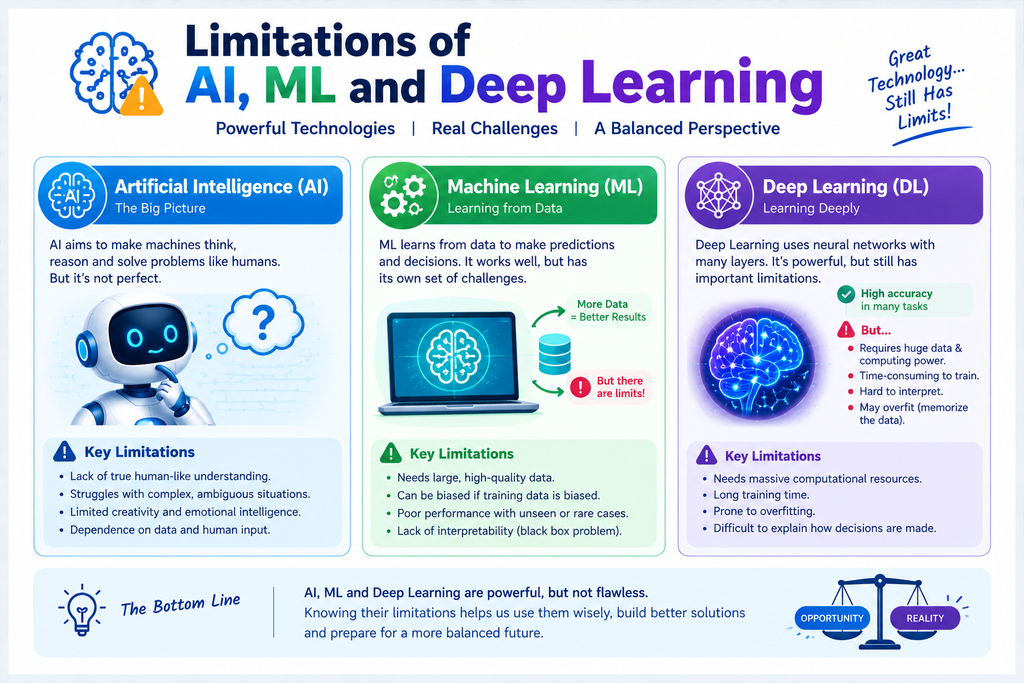
It is also important to understand that these technologies have limitations.
AI Limitations
AI systems can make mistakes, misunderstand context, or produce inappropriate results.
Machine Learning Limitations
Machine Learning depends heavily on the quality and relevance of training data. A model can perform poorly when real-world data differs significantly from its training environment.
Deep Learning Limitations
Deep Learning can require large datasets, powerful computing resources, and substantial training time.
Deep-learning models can also be difficult to interpret, particularly when users need to understand why a model produced a particular result.
This is why responsible AI development includes attention to issues such as fairness, safety, privacy, transparency, and accountability. Google also provides introductory resources covering responsible AI principles. (Google for Developers)
AI vs Machine Learning vs Deep Learning.
Which Is Better: AI, Machine Learning, or Deep Learning?
This is actually the wrong question.
AI, Machine Learning, and Deep Learning serve different purposes.
Instead of asking:
“Which one is better?”
ask:
“Which technology is appropriate for this problem?”
For a simple rule-based task, traditional AI may be enough.
For prediction and classification based on structured data, Machine Learning may be suitable.
For complex image, speech, language, or other high-dimensional problems, Deep Learning may be more appropriate.
The technology should be selected according to the problem rather than simply choosing the most advanced option.
AI vs Machine Learning vs Deep Learning.
AI vs ML vs DL: A Simple Real-Life Analogy
Imagine you want to build a system that can recognize different types of fruit.
AI
The overall goal is to create a machine capable of identifying fruit.
Machine Learning
You provide the machine with examples of apples, bananas, oranges, and other fruits. The model learns patterns that help it classify new examples.
Deep Learning
A deep neural network processes large numbers of fruit images and automatically learns increasingly complex visual features.
So:
AI = the overall intelligence goal
ML = learning patterns from data
DL = using deep neural networks to learn complex patterns
This simple analogy makes the relationship much easier to remember.
AI vs Machine Learning vs Deep Learning.
How AI, Machine Learning, and Deep Learning Work Together
Modern technology often combines all three.
Consider an AI-powered medical imaging system.
The overall application is an AI system.
A Machine Learning model may be responsible for making predictions from medical data.
A Deep Learning neural network may process complex medical images.
So a single application can involve:
AI → ML → Deep Learning
This layered approach is common in modern AI systems.
AI vs Machine Learning vs Deep Learning.
Are ChatGPT and Generative AI Machine Learning or Deep Learning?
Generative AI belongs within the broader AI landscape and relies heavily on Machine Learning and Deep Learning.
Large language models, for example, use sophisticated neural-network architectures trained on large datasets.
Therefore, it is reasonable to think of many modern generative AI applications as:
AI applications powered by Machine Learning and Deep Learning.
This is why learning the fundamentals of AI, ML, and DL can help beginners understand how modern generative AI works.
Learn-“How ChatGPT works.”
AI vs Machine Learning vs Deep Learning.
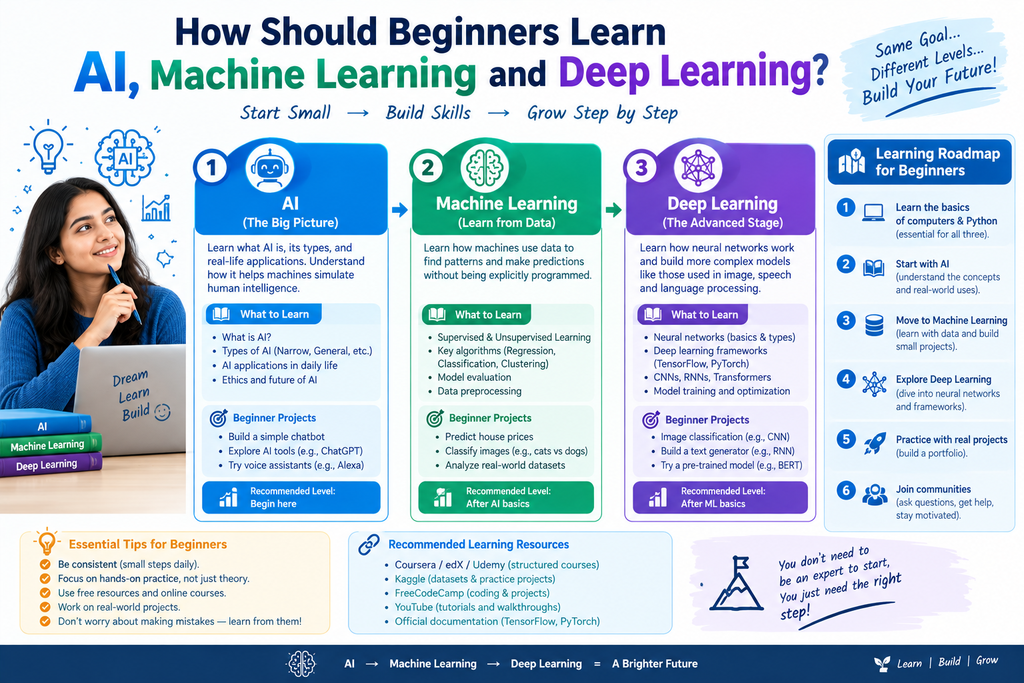
How Should Beginners Learn AI, Machine Learning, and Deep Learning?
AI vs Machine Learning vs Deep Learning
If you are completely new to AI, don’t start by trying to learn everything simultaneously.
A better approach is to learn step by step.
Step 1: Understand AI
First, learn what AI is, how it is used, and where you encounter it in everyday life.
Step 2: Learn Machine Learning Basics
Understand concepts such as:
- Training data
- Features
- Labels
- Models
- Predictions
- Classification
- Regression
- Supervised learning
- Unsupervised learning
Google offers beginner-oriented Machine Learning courses and guides that can help learners build foundational knowledge. (Google for Developers)
Step 3: Learn About Neural Networks
Once you understand basic ML concepts, explore neural networks and how they process information.
Step 4: Explore Deep Learning
Learn how multilayer neural networks are trained and how they are applied to images, text, speech, and other complex data.
Step 5: Experiment With AI Tools
Finally, use practical AI tools and projects to connect theory with real-world applications.
AI vs Machine Learning vs Deep Learning.
Learn-“Step-by-step roadmap for learning AI.”
AI vs Machine Learning vs Deep Learning: Key Takeaways
Let’s summarize the most important points.
AI vs Machine Learning vs Deep Learning.
- Artificial Intelligence is the broadest concept.
- Machine Learning is a subset of AI.
- Deep Learning is a subset of Machine Learning.
- AI focuses on creating systems capable of intelligent behavior.
- Machine Learning allows systems to learn patterns from data.
- Deep Learning uses multilayer neural networks to learn complex patterns.
- Machine Learning can work effectively with structured data and many different algorithms.
- Deep Learning is particularly powerful for complex data such as images, speech, and language.
- Deep Learning generally requires greater computing resources and large amounts of data.
- Not every AI system uses Machine Learning.
- Not every Machine Learning system uses Deep Learning.
- Choosing the right technology depends on the specific problem.
AI vs Machine Learning vs Deep Learning.
Frequently Asked Questions About AI vs Machine Learning vs Deep Learning
Is AI the same as Machine Learning?
No. AI is the broader field, while Machine Learning is a subset of AI. Machine Learning focuses on systems that learn patterns from data. (IBM)
AI vs Machine Learning.
Is Deep Learning a type of AI?
Yes. Deep Learning is a subset of Machine Learning, which is itself a subset of AI.
Which is more advanced: Machine Learning or Deep Learning?
Deep Learning is generally considered a more specialized approach within Machine Learning and can handle highly complex problems, but that does not mean it is always the best choice.
Machine Learning vs Deep Learning.
Does AI always require Machine Learning?
No. AI can also use rule-based systems, search methods, logic, and other approaches. Machine Learning is one important way of building AI systems.
Is ChatGPT AI or Machine Learning?
ChatGPT is an AI application that relies on Machine Learning and Deep Learning technologies. Modern generative AI systems are built using sophisticated machine-learning models.
Do I need programming to understand AI?
No. Beginners can learn the fundamental concepts of AI without programming. Programming becomes increasingly useful if you want to build AI or Machine Learning systems yourself.
Which should beginners learn first: AI, ML, or Deep Learning?
Start with AI fundamentals, then learn basic Machine Learning, followed by Deep Learning. This order makes the relationship between the technologies easier to understand.
AI vs Machine Learning vs Deep Learning.
Final Thoughts
Understanding AI vs Machine Learning vs Deep Learning doesn’t have to be complicated.
The simplest way to remember the relationship is:
Artificial Intelligence is the big picture. Machine Learning is a way of achieving AI by learning from data. Deep Learning is a specialized form of Machine Learning that uses multilayer neural networks.
AI is becoming increasingly important in everyday life, business, education, healthcare, software development, entertainment, and many other fields. Learning the difference between these technologies gives beginners a stronger foundation for understanding everything from recommendation systems to modern generative AI.
You don’t need to become a programmer or data scientist immediately. Start with the fundamentals, understand the terminology, experiment with beginner-friendly AI tools, and gradually explore Machine Learning and Deep Learning.
The more clearly you understand these three concepts, the easier it becomes to understand how modern AI systems actually work—and where AI technology may take us next.
AI vs Machine Learning vs Deep Learning.
Call to Action
For readers who want to continue learning, explore:
- What Is AI? A Simple Beginner’s Guide to Artificial Intelligence (2026)
- How Does Artificial Intelligence Work? A Simple Guide for Beginners (2026)
- Types of Artificial Intelligence Explained for Beginners
- 10 Real-Life Examples of AI in Everyday Life
- What Is ChatGPT and How Does It Work? The Complete Beginner’s Guide (2026)
- How to Start Learning AI Step-by-Step: Beginner Roadmap 2026
Follow NextGenAIToolNest for more AI guides, automation tips, and online earning strategies.
3 Comments