
 By
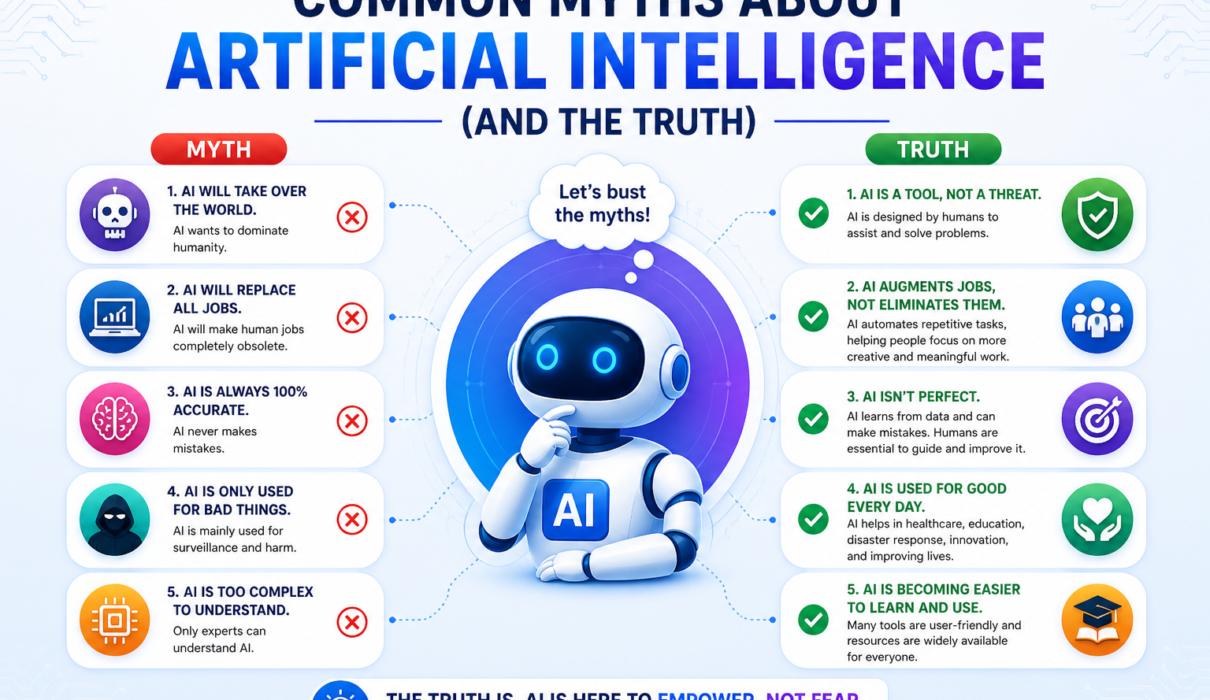
By Common Myths About Artificial Intelligence (And the Truth)
Introduction
Artificial Intelligence (AI) has become one of the most talked-about technologies in the world. From ChatGPT and AI image generators to self-driving technology and intelligent recommendation systems, AI is rapidly changing how people work, learn, communicate, and create.
But as AI becomes more popular, so do misunderstandings about what it can actually do.
Some people believe AI will replace every human worker. Others think AI has human-like intelligence, always provides correct information, or will eventually become conscious and take control of the world. These ideas are often influenced by science fiction, sensational headlines, or misunderstandings about how modern AI systems work.
The reality is much more nuanced.
In this beginner-friendly guide, we’ll explore the common myths about Artificial Intelligence, separate AI facts from fiction, and explain what today’s AI technology can—and cannot—do.
Understanding these myths is important because it allows beginners to use AI more effectively, responsibly, and realistically.
What Is Artificial Intelligence?
Before examining AI myths, it helps to understand what Artificial Intelligence actually means.
AI refers broadly to computer systems designed to perform tasks that normally require capabilities associated with human intelligence, such as recognizing patterns, understanding language, making predictions, generating content, or solving certain problems.
Modern AI systems can perform impressive tasks, but they do not necessarily understand the world in the same way humans do.
For beginners who want to understand the fundamentals, our guide [What Is Artificial Intelligence (AI)? A Complete Beginner’s Guide] is a useful place to start.
AI includes technologies such as:
- Machine learning
- Deep learning
- Natural language processing
- Computer vision
- Generative AI
- Speech recognition
- Recommendation systems
Myth 1: AI Is the Same as Human Intelligence
The Myth
A common misconception is that AI thinks and understands the world exactly like a human being.
The Truth
AI systems can perform certain tasks that appear intelligent, but this doesn’t mean they possess human-like understanding or consciousness.
For example, a generative AI system can produce an essay, summarize information, or answer questions. However, its capabilities come from patterns learned from data and the algorithms used to process information.
Human intelligence involves many complex abilities, including:
- Emotional understanding
- Common-sense reasoning
- Self-awareness
- Social understanding
- Physical experience
- General-purpose learning
Today’s AI can outperform humans in specific tasks while remaining limited in other areas.
Beginner Takeaway
Think of AI as a powerful technology designed for particular tasks—not necessarily as a digital human.
Artificial Intelligence facts.
Myth 2: AI Will Replace All Human Jobs
The Myth
One of the biggest fears surrounding AI is that machines will eventually eliminate almost every human job.
The Truth
AI is likely to automate some tasks and transform many occupations, but that doesn’t necessarily mean all jobs will disappear.
Many jobs consist of numerous tasks. AI may automate certain repetitive tasks while humans continue handling responsibilities requiring judgment, communication, creativity, leadership, empathy, or physical interaction.
For example, a marketing professional might use AI to generate initial content ideas but still make the final strategic decisions.
Similarly, a software developer may use AI to assist with coding while remaining responsible for architecture, testing, security, and product decisions.
The important question isn’t simply:
“Will AI replace humans?”
A more useful question is:
“Which tasks will AI automate, and how will human work change?”
Beginner Takeaway
Learning how to work effectively with AI may become an increasingly valuable professional skill.
You can explore practical AI skills in our article [Skills You Need to Learn Artificial Intelligence].
Artificial Intelligence facts.
Myth 3: AI Always Gives Correct Answers
The Myth
Many beginners assume that because an AI system sounds confident, its answers must be accurate.
The Truth
AI systems can produce incorrect, incomplete, outdated, or misleading information.
Generative AI can sometimes produce what are commonly called “hallucinations”—outputs that appear plausible but aren’t supported by reliable evidence.
This is especially important when using AI for:
- Medical information
- Financial decisions
- Legal questions
- Academic research
- Current events
- Technical information
AI should therefore be treated as an assistant rather than an unquestionable authority.
How to Use AI More Safely
When information matters:
- Ask the AI to explain its reasoning or sources where appropriate.
- Check important claims against reliable sources.
- Compare information from multiple sources.
- Apply human judgment.
- Avoid blindly copying AI-generated information.
Myth 4: AI Is Completely Autonomous
The Myth
Movies often portray AI as an independent entity capable of making unlimited decisions without human involvement.
The Truth
Most real-world AI systems operate within specific technical, organizational, and human-defined boundaries.
An AI system generally depends on:
- Data
- Software
- Computing infrastructure
- Algorithms or models
- Human-defined objectives
- System permissions
Even advanced AI systems operate within the capabilities and limitations established by their design and deployment.
Human oversight remains particularly important in high-impact applications.
Artificial Intelligence facts.
Myth 5: AI Can Learn Anything Instantly
The Myth
Some people assume that AI can immediately learn any new subject simply by receiving a question.
The Truth
AI systems have limitations concerning training, context, access to information, and the specific capabilities available in a particular application.
A model may have broad knowledge while still lacking current information or specialized expertise.
Some AI applications can use external tools, databases, or web resources, but those capabilities depend on how the system is designed.
Beginner Takeaway
Don’t assume that an AI tool automatically knows everything. Always consider its data, capabilities, and limitations.
Myth 6: AI Is Only Useful for Technology Experts
The Myth
AI is sometimes viewed as a complicated technology that only programmers, engineers, or data scientists can use.
The Truth
AI tools are increasingly designed for ordinary users.
You can use AI for:
- Writing
- Brainstorming
- Learning
- Translation
- Image creation
- Research assistance
- Presentations
- Productivity
- Data analysis
You don’t necessarily need programming knowledge to start using many modern AI applications.
If you’re new to the field, our guide [25 Best AI Tools for Beginners in 2026] can help you discover beginner-friendly tools.
![[25 Best AI Tools for Beginners in 2026]](https://nextgenaitoolnest.com/wp-content/uploads/2026/07/25-Best-AI-Tools-for-Beginners-in-2026_image.png)
Myth 7: AI Will Become Conscious Soon
The Myth
Science fiction frequently depicts AI systems becoming conscious, developing emotions, and deciding to control humanity.
The Truth
There is no established evidence that today’s mainstream AI systems are conscious in the human sense.
An AI can generate text such as “I feel happy,” but generating that sentence doesn’t prove that the system actually experiences happiness.
Human consciousness is a complex scientific and philosophical subject, and claims about future machine consciousness remain speculative.
Beginner Takeaway
Separate science fiction from current AI capabilities.
AI can imitate human-like communication without necessarily possessing human-like subjective experiences.
Artificial Intelligence facts.
Myth 8: AI Has No Creativity
The Myth
Another misconception is that AI can only repeat information and therefore cannot participate in creative work.
The Truth
Generative AI can produce:
- Stories
- Images
- Music
- Videos
- Marketing concepts
- Design ideas
- Poems
- Brainstorming suggestions
However, the nature of AI creativity is different from human creativity.
Humans bring personal experiences, emotions, cultural knowledge, intentions, and lived experiences to creative work.
AI can provide ideas and generate variations, but human direction and judgment remain extremely valuable.
For content creators, AI can be particularly useful as a brainstorming and production assistant.
Myth 9: AI Is Always Expensive
The Myth
Some people believe that using AI requires expensive software, powerful computers, or a large technology budget.
The Truth
Many AI tools offer free plans, free trials, or limited free access.
Beginners can explore AI without making a major financial investment.
Free or accessible AI tools can help with:
- Writing
- Image generation
- Research
- Learning
- Productivity
- Translation
- Brainstorming
However, free plans often have usage limits, while professional users may benefit from paid subscriptions.
Our guide [Free Resources to Learn Artificial Intelligence] provides additional options for beginners who want to learn AI without spending much money.
Myth 10: AI Is Always Unbiased
The Myth
Because computers use mathematical algorithms, some people assume AI systems are automatically objective and unbiased.
The Truth
AI systems can reflect biases present in their training data, design choices, evaluation processes, or deployment environments.
If the data used to develop a system contains problematic patterns, the resulting system can potentially reproduce or amplify them.
That’s why responsible AI development involves:
- Testing
- Monitoring
- Evaluation
- Human oversight
- Diverse datasets
- Transparency
- Risk assessment
AI should not automatically be considered neutral simply because it is computer-based.
Artificial Intelligence facts.
Myth 11: AI Understands Everything It Says
The Myth
When an AI produces a detailed explanation, it can appear as though it deeply understands every statement.
The Truth
The appearance of understanding and actual understanding are not necessarily the same thing.
Generative AI systems can produce highly coherent language by processing patterns and relationships learned from data. Their outputs can be remarkably useful, but they can also contain errors or contradictions.
This is why human review remains important, particularly for important decisions.
Practical Tip
Instead of asking:
“Can I trust everything this AI says?”
Ask:
“How can I verify the information this AI provides?”
That mindset will help you become a more effective AI user.
Myth 12: AI Will Make Humans Unnecessary
The Myth
If AI becomes better at writing, designing, analyzing data, and solving problems, some people believe humans will eventually become unnecessary.
The Truth
AI is a technology created and used by people.
Human abilities such as:
- Empathy
- Leadership
- Ethical judgment
- Creativity
- Collaboration
- Communication
- Critical thinking
- Responsibility
remain extremely important.
The future is more likely to involve collaboration between humans and AI rather than simply one replacing the other.
Artificial Intelligence facts.
Myth 13: AI Is Only About Chatbots
The Myth
Because chatbots are currently one of the most visible AI applications, some beginners assume that AI is basically another name for chatbots.
The Truth
Chatbots are only one application of AI.
Artificial Intelligence is also used in:
- Search engines
- Recommendation systems
- Fraud detection
- Medical imaging
- Autonomous systems
- Robotics
- Computer vision
- Speech recognition
- Cybersecurity
- Manufacturing
- Scientific research
You can learn more about everyday applications in [Artificial Intelligence (AI) in Daily Life – A Complete Guide].
Artificial Intelligence facts.
AI Myths vs. Reality: Quick Comparison
| AI Myth | Reality |
|---|---|
| AI is human intelligence | AI performs specific tasks using computational systems |
| AI will replace every job | AI is more likely to automate tasks and transform jobs |
| AI is always accurate | AI can make mistakes and generate false information |
| AI is completely autonomous | AI operates within technical and human-defined boundaries |
| AI knows everything | AI has knowledge and capability limitations |
| Only programmers can use AI | Many AI tools are designed for everyday users |
| AI is conscious | Current AI systems should not be assumed to be conscious |
| AI has no creativity | Generative AI can produce creative outputs |
| AI is always expensive | Many tools offer free or low-cost options |
| AI is automatically unbiased | AI can inherit or amplify biases |
| AI understands everything | Fluent output does not guarantee genuine understanding |
| AI will make humans unnecessary | Human judgment and skills remain essential |
Artificial Intelligence facts.
Why Understanding AI Myths Matters
Understanding common myths about Artificial Intelligence isn’t just about correcting misconceptions. It can help you make better decisions about how you use AI.
If you believe AI is perfect, you might trust inaccurate information.
If you believe AI will replace every job, you might overlook opportunities to develop valuable AI-related skills.
If you believe AI is only for programmers, you might miss useful tools that can improve your everyday productivity.
A realistic understanding of AI allows you to take advantage of its benefits while recognizing its limitations.
Artificial Intelligence facts.
How Beginners Can Use AI Responsibly
If you’re beginning your AI journey, follow these simple principles:
1. Verify Important Information
Don’t blindly trust AI-generated answers when the consequences of an error could be serious.
2. Protect Personal Information
Avoid entering confidential, financial, or sensitive personal information into AI tools unless you understand how the service handles that information.
3. Keep Human Oversight
Use AI to assist your decisions rather than automatically surrendering responsibility to it.
4. Develop AI Literacy
Learn basic concepts such as machine learning, generative AI, prompts, training data, and AI limitations.
5. Continue Learning
AI technology changes quickly. Follow reliable sources and update your knowledge regularly.
Artificial Intelligence facts.
The Future of AI: What Should Beginners Expect?
AI will likely become increasingly integrated into everyday software, education, business, creative tools, and digital services.
Rather than thinking of AI as a separate technology that you occasionally use, it may become an ordinary component of many applications.
For beginners, this creates an important opportunity.
You don’t necessarily need to become an AI engineer. Understanding how to use AI effectively, evaluate its outputs, protect your information, and combine AI with human skills can be extremely valuable.
AI Myths and misconceptions.
Frequently Asked Questions
What are the most common myths about Artificial Intelligence?
Some of the most common AI myths are that AI is already equivalent to human intelligence, will replace every job, always provides accurate information, is completely autonomous, and will inevitably become conscious.
The reality is considerably more complex.
AI Myths and misconceptions.
Is AI actually intelligent?
AI can perform tasks that appear intelligent, such as recognizing patterns, generating language, and making predictions. However, these capabilities should not automatically be equated with human intelligence, consciousness, or understanding.
Will AI replace human workers?
AI can automate some tasks and transform many jobs. However, humans continue to provide skills such as judgment, creativity, leadership, empathy, and accountability.
Can AI make mistakes?
Yes. AI systems can generate inaccurate or misleading information. Important information should therefore be independently verified.
Is AI safe for beginners?
AI tools can be useful for beginners, but responsible use is important. Users should protect personal information, verify important outputs, and understand the limitations of the tools they use.
Can AI be creative?
Generative AI can produce creative outputs such as text, images, music, and design concepts. Human creativity remains important for defining goals, providing context, evaluating results, and adding personal meaning.
Do I need coding skills to use AI?
No. Many modern AI applications are designed for non-programmers. Coding becomes more important if you want to build AI systems or work professionally in technical AI fields.
AI Myths and misconceptions.
Final Verdict: AI Facts vs. Fiction
Artificial Intelligence is powerful, but it is neither magical nor identical to human intelligence.
The truth lies somewhere between the extreme claims that “AI can do everything” and “AI is just a simple computer program.”
Today’s AI can automate tasks, analyze information, generate content, recognize patterns, and assist people across many industries. At the same time, it can make mistakes, reflect biases, lack reliable understanding, and require human supervision.
For beginners, the best approach is neither to fear AI nor blindly trust it.
Learn how it works. Understand its limitations. Experiment with useful tools. Verify important information. And combine AI capabilities with human judgment and creativity.
That balanced approach will help you make the most of Artificial Intelligence in 2026 and beyond.
AI Myths and misconceptions.
Suggested Internal Links
Use these internal links naturally throughout your article:
- What Is Artificial Intelligence (AI)? A Complete Beginner’s Guide
- 25 Best AI Tools for Beginners in 2026
- Best AI Writing Tools Compared (2026)
- Best AI Image Generators Ranked (2026)
- What Is ChatGPT and How Does It Work?
- Free Resources to Learn Artificial Intelligence
- Skills You Need to Learn Artificial Intelligence
- Artificial Intelligence (AI) in Daily Life – A Complete Guide
- AI vs Machine Learning vs Deep Learning
- Ultimate Benefits of Artificial Intelligence for Beginners
Recommended Outbound Links
For authoritative information, consider linking to:
- Stanford AI Index
- NIST – Artificial Intelligence
- UNESCO – Recommendation on the Ethics of Artificial Intelligence
- UNESCO – AI Ethics and Bias
- UNESCO – AI and Society
These authoritative resources can provide readers with additional information about AI technology, responsible AI, research, and emerging developments.
AI Myths and misconceptions.
Call to Action
Hope you like our Blog 8: Common Myths About Artificial Intelligence (And the Truth)
If you’re just starting, don’t miss our previous AI for Beginners.
Follow NextGenAIToolNest for more AI guides, automation tips, and online earning strategies.
2 Comments