
 By
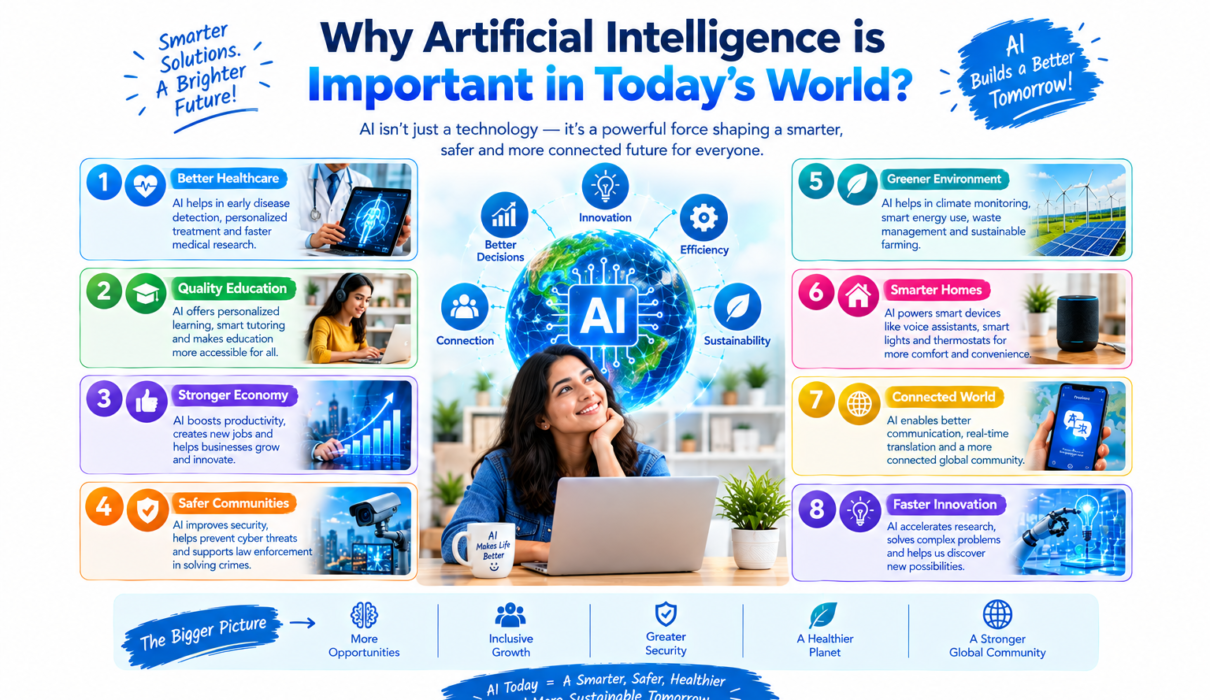
Why Artificial Intelligence is important?
Artificial Intelligence (AI) has moved from being a futuristic idea to becoming an important part of modern life. From smartphones and search engines to healthcare, education, transportation, business, and scientific research, AI is changing how people work, learn, communicate, and solve problems.
But why is Artificial Intelligence important in today’s world?
Importance of Artificial Intelligence-
The answer goes beyond chatbots and generative AI. Artificial Intelligence can analyze enormous amounts of information, recognize patterns, automate repetitive tasks, support decision-making, personalize experiences, and help people tackle problems that would otherwise require significant amounts of time and resources.
IBM defines AI as technology that enables computers and machines to simulate capabilities such as learning, problem-solving, decision-making, creativity, and understanding.
At the same time, AI is not automatically beneficial in every situation. Its growing importance also makes responsible development, human oversight, privacy, security, and AI literacy increasingly important.
In this beginner-friendly guide, we will explore why Artificial Intelligence is important, how AI is changing different industries, its benefits, its challenges, and why understanding AI can be valuable for individuals and businesses in 2026.
Importance of artificial intelligence.

What Is Artificial Intelligence?
Before understanding the importance of Artificial Intelligence, it helps to understand what AI actually means.
Artificial Intelligence is a broad field of technology focused on creating computer systems capable of performing tasks that normally require aspects of human intelligence.
These capabilities can include:
- Learning from information
- Recognizing patterns
- Understanding language
- Analyzing images
- Making predictions
- Generating content
- Solving problems
- Supporting decisions
- Automating tasks
AI includes technologies such as Machine Learning, Deep Learning, Natural Language Processing, Computer Vision, and Generative AI.
For example, when an AI system identifies an object in an image, recommends a product, translates text, summarizes a document, or responds to a question, it is using some form of artificial intelligence.
Also read:- “what Artificial Intelligence actually is”.
Importance of Artificial Intelligence.
Why Is Artificial Intelligence Important Today?
Artificial Intelligence is important because the world is producing more information, facing increasingly complex problems, and demanding faster and more personalized services.
AI can help people and organizations process information, automate suitable tasks, identify patterns, and make more informed decisions.
The OECD describes AI as a transformative general-purpose technology that is reshaping economies and societies, while also noting that its effects depend heavily on skills, adoption, and how the transition is managed.
Here are some of the major reasons why Artificial Intelligence is important in today’s world.
1. AI Automates Repetitive Tasks
One of the most important benefits of Artificial Intelligence is automation.
Many jobs involve repetitive activities such as:
- Data entry
- Document classification
- Scheduling
- Basic customer support
- Information extraction
- Routine reporting
- Sorting large datasets
AI can assist with many of these tasks, allowing people to spend more time on activities requiring judgment, creativity, communication, and problem-solving.
For example, an AI-powered system might automatically organize incoming customer requests and direct them to the appropriate department.
This doesn’t necessarily mean that humans become unnecessary. Instead, AI can change how human workers spend their time.
The OECD’s 2026 research describes three major ways AI can affect work: automation of existing tasks, creation of new tasks and occupations, and productivity improvements.
2. AI Can Increase Productivity
Productivity is another major reason for the growing importance of AI.
AI tools can help people complete certain tasks faster by assisting with:
- Research
- Writing
- Coding
- Data analysis
- Summarization
- Customer service
- Content creation
- Information retrieval
Businesses are increasingly using AI to streamline workflows, improve customer experiences, analyze data, and support decision-making.
For an individual, an AI assistant might summarize a long document in seconds.
For a business, AI might analyze thousands of customer interactions to identify common problems.
The result can be less time spent on suitable routine tasks and more time available for higher-value activities.
Importance of AI.
3. AI Helps Analyze Large Amounts of Data
Modern organizations generate enormous quantities of data.
This data can come from:
- Websites
- Smartphones
- Sensors
- Financial transactions
- Customer interactions
- Medical records
- Scientific experiments
- Social media
- Business operations
Humans can analyze only a limited amount of information manually.
AI can help process large datasets and identify patterns that may be difficult to detect using traditional methods.
For example, businesses can use AI to identify changing customer preferences, while researchers can use AI to analyze complex scientific datasets.
The ability to process large quantities of information is one reason AI has become important across science, business, healthcare, transportation, and other sectors.
Importance of AI.
4. AI Supports Better Decision-Making
AI can also help people make more informed decisions by analyzing relevant information and identifying patterns.
For example:
- A business can use AI to forecast demand.
- A bank can use AI to detect unusual transactions.
- A logistics company can analyze routes.
- A manufacturer can predict equipment maintenance needs.
- A healthcare organization can use AI to support clinical workflows.
AI should not automatically be treated as the final decision-maker, particularly when decisions have significant consequences.
Instead, AI can provide information, predictions, or recommendations that humans can evaluate.
This combination of AI assistance + human judgment is an important approach to using AI responsibly.
Importance of AI.
5. AI Is Transforming Healthcare
Healthcare is one of the areas where Artificial Intelligence can have significant practical importance.
AI is being used for applications including:
- Medical imaging analysis
- Administrative automation
- Clinical decision support
- Patient communication
- Research
- Drug discovery
- Personalized care
IBM’s 2026 overview of AI in healthcare notes that AI can help automate routine work, make better use of data, support clinical decision-making, and contribute to more efficient and personalized care.
For example, AI systems can assist healthcare professionals in analyzing medical images or organizing information.
However, healthcare AI requires careful validation, privacy protection, professional oversight, and appropriate regulation.
AI should be viewed as a tool that can support healthcare professionals rather than as a replacement for professional medical judgment.
Importance of AI.
6. AI Is Changing Education
Importance of AI in education-
Education is another area where AI is becoming increasingly important.
AI-powered tools can help students and teachers with:
- Personalized learning
- Explanations
- Practice questions
- Writing assistance
- Language learning
- Research support
- Lesson preparation
- Feedback
A student struggling with a difficult concept can ask an AI tool to explain the subject in simpler language.
A teacher can use AI to brainstorm lesson ideas or create practice material.
However, using AI effectively requires critical thinking.
Recent OECD findings emphasize that students need the ability to evaluate AI-generated information, distinguish evidence from opinion, and avoid simply consuming ready-made answers.
This makes AI literacy an increasingly important part of modern education.
Read:- “AI in education”
Importance of AI in education.
7. AI Is Changing the Way Businesses Work
Importance of AI in business-
Businesses are among the biggest adopters of Artificial Intelligence.
AI can help companies:
- Automate routine workflows
- Analyze customer data
- Improve customer service
- Detect fraud
- Forecast demand
- Optimize operations
- Generate content
- Support employees
- Improve decision-making
According to the OECD, AI adoption can reduce costs and increase productivity, while also changing operational efficiency, decision-making, and consumer engagement.
IBM similarly describes business AI applications across areas such as customer experience, workflow automation, forecasting, cybersecurity, content creation, and real-time decision-making.
This explains why understanding AI is becoming increasingly useful not only for technology companies but also for organizations in finance, manufacturing, retail, education, healthcare, marketing, and many other sectors.
Importance of AI in business.
8. AI Improves Everyday Digital Experiences
Many people interact with AI without consciously thinking about it.
Examples include:
- Search engines
- Smartphone cameras
- Voice assistants
- Navigation applications
- Recommendation systems
- Email spam filters
- Online shopping
- Social media feeds
- Translation tools
- Streaming services
For example, when a streaming platform recommends a movie, an AI system may analyze patterns in viewing behavior.
When a navigation application suggests a route, algorithms can process information about roads and traffic.
These everyday examples show that AI is not limited to laboratories or large technology companies.
It is already integrated into many digital products and services.
Also read:- “real-life examples of AI in everyday life”.
9. AI Helps Scientific Research and Innovation
Scientific research often involves enormous datasets and complicated problems.
AI can assist researchers by:
- Analyzing scientific data
- Finding patterns
- Generating hypotheses
- Supporting simulations
- Analyzing scientific literature
- Assisting experimental design
- Helping identify relationships in complex datasets
The OECD has documented AI applications in scientific research ranging from analysis of large datasets to literature analysis, experimental design, genetics, chemistry, and astronomy.
This makes AI important not only for today’s technology but also for discovering new knowledge.
Importance of AI.
10. AI Can Help Solve Complex Problems
Some problems are too complicated or data-intensive to solve efficiently using traditional approaches alone.
AI can help analyze complex relationships and explore potential solutions.
Examples include:
- Climate research
- Energy optimization
- Traffic management
- Disease research
- Supply-chain planning
- Scientific modeling
- Cybersecurity
- Disaster response
The OECD identifies potential applications of AI in areas ranging from healthcare and education to agriculture, transportation, manufacturing, energy, and climate action.
AI doesn’t magically solve these problems, but it can provide additional analytical capabilities that humans can use.
Importance of AI.
11. AI Is Creating New Opportunities
The importance of AI is not only about automation.
AI is also creating new tools, products, services, and areas of work.
Examples include:
- AI product development
- Machine Learning engineering
- Data science
- AI safety
- AI governance
- AI education
- AI consulting
- Prompt and workflow design
- AI-powered entrepreneurship
At the same time, AI is changing the skills required in many existing occupations.
The OECD’s 2026 research emphasizes that skills are a major factor determining whether economies and workers benefit from AI. It also highlights the continuing importance of digital skills, data literacy, problem-solving, creativity, innovation, communication, and teamwork.
This means that learning about AI does not necessarily mean becoming an AI engineer.
For many people, the more useful goal may be learning how to work effectively with AI.
Importance of AI.
12. AI Can Improve Accessibility
AI can also make technology more accessible.
Examples include:
- Speech-to-text systems
- Text-to-speech systems
- Automatic captions
- Translation tools
- Image descriptions
- Voice interfaces
- Assistive communication tools
These technologies can help people interact with digital information in different ways.
As AI language and vision capabilities improve, accessibility applications may continue to expand.
Importance of AI.
13. AI Supports Cybersecurity and Fraud Detection
As digital activity increases, cybersecurity becomes increasingly important.
AI can help security teams identify unusual patterns and potentially suspicious activity.
Applications can include:
- Fraud detection
- Anomaly detection
- Threat analysis
- Email security
- Network monitoring
- Identity protection
For example, a financial system can analyze transaction patterns and flag activity that appears unusual.
AI doesn’t eliminate cybersecurity risks, but it can help organizations analyze large quantities of security-related information more efficiently.
Importance of AI.
14. AI Is Important for the Future of Work
One of the biggest discussions surrounding AI concerns employment.
AI can automate some tasks, augment others, and create demand for new activities.
The OECD’s 2026 research says the effects on employment depend on the balance among task automation, new tasks and occupations, and productivity improvements. It also notes that workers in routine and repetitive roles may face greater displacement risks.
Therefore, the importance of AI for workers is not simply about learning a specific AI tool.
It is also about developing adaptable skills.
Useful skills include:
- Digital literacy
- Critical thinking
- Communication
- Problem-solving
- Creativity
- Data literacy
- AI literacy
- Domain expertise
Learning how to evaluate AI output is just as important as learning how to generate it.
15. AI Can Help Small Businesses
AI isn’t only useful for large corporations.
Small businesses can use AI tools for:
- Marketing ideas
- Customer support
- Content creation
- Data analysis
- Administrative work
- Market research
- Email drafting
- Scheduling assistance
- Product descriptions
This can give smaller organizations access to capabilities that previously required larger teams.
However, businesses should evaluate AI tools based on factors such as cost, reliability, privacy, security, accuracy, and the importance of the task.
Importance of AI.
Importance of AI.
AI and Human Intelligence: Why Both Matter
Understanding why Artificial Intelligence is important does not mean believing that AI should replace human intelligence.
AI and humans have different strengths.
AI can be very useful for:
- Processing large datasets
- Recognizing patterns
- Automating repetitive tasks
- Generating drafts
- Performing calculations
- Finding information
Humans remain essential for:
- Judgment
- Empathy
- Ethical reasoning
- Context
- Accountability
- Creativity
- Relationships
- Complex social decisions
The most useful future may therefore involve humans and AI working together.
The OECD notes that AI can complement human labor and contribute to productivity while also creating risks of displacement in some types of work.
Importance of AI.
Why AI Literacy Is Becoming Important
You don’t need to become an AI programmer to understand Artificial Intelligence.
But basic AI literacy can help you:
- Understand AI terminology
- Use AI tools effectively
- Recognize AI-generated content
- Check AI responses
- Protect personal information
- Understand AI limitations
- Make better technology decisions
This is particularly important because AI tools are becoming part of education, workplaces, consumer products, and everyday digital services.
In 2026, the ability to work with AI critically and responsibly is becoming an increasingly useful general skill.
Importance of AI.
Challenges of Artificial Intelligence
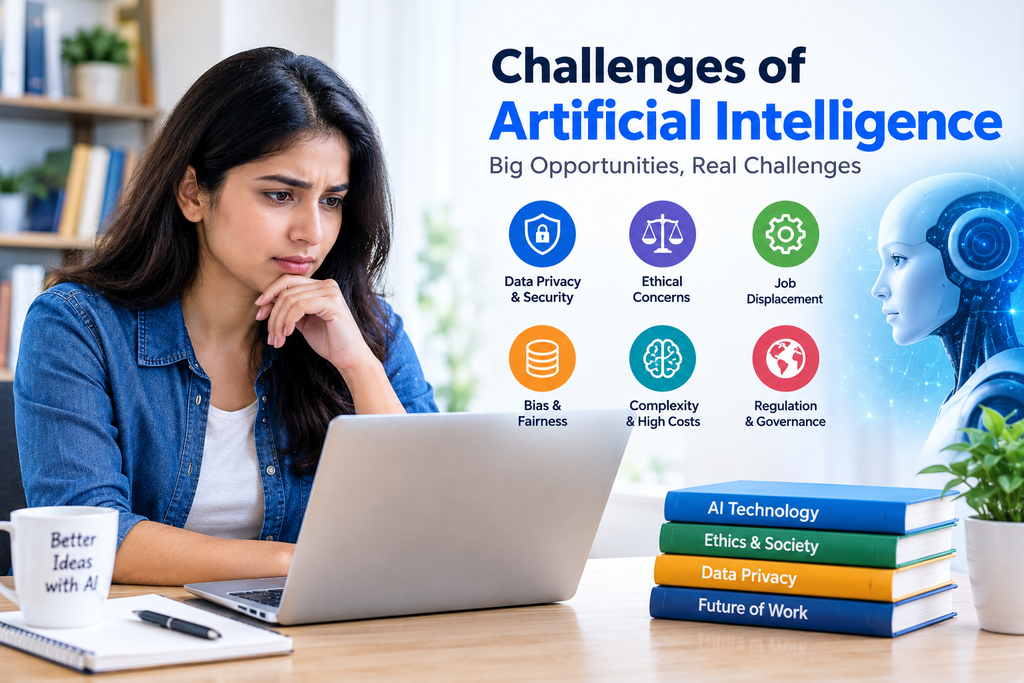
Although AI offers significant opportunities, it also creates challenges.
1. Privacy
AI systems may process large amounts of personal or organizational information. Data protection is therefore important.
2. Bias
AI systems can produce biased results when their data, design, or deployment contains problematic assumptions or patterns.
3. Accuracy
AI systems can generate incorrect or misleading information.
Users should verify important information rather than automatically trusting AI output.
4. Security
AI can create new cybersecurity opportunities as well as new risks.
5. Job Displacement
Some tasks and roles may be automated, particularly where work is repetitive and predictable.
6. Overdependence
Using AI for every task can reduce opportunities for people to develop their own reasoning and problem-solving skills.
7. Governance
AI systems need appropriate rules, oversight, testing, and accountability.
The OECD emphasizes that AI can bring benefits while also posing risks involving privacy, safety, security, and human autonomy.
How to Use AI Responsibly
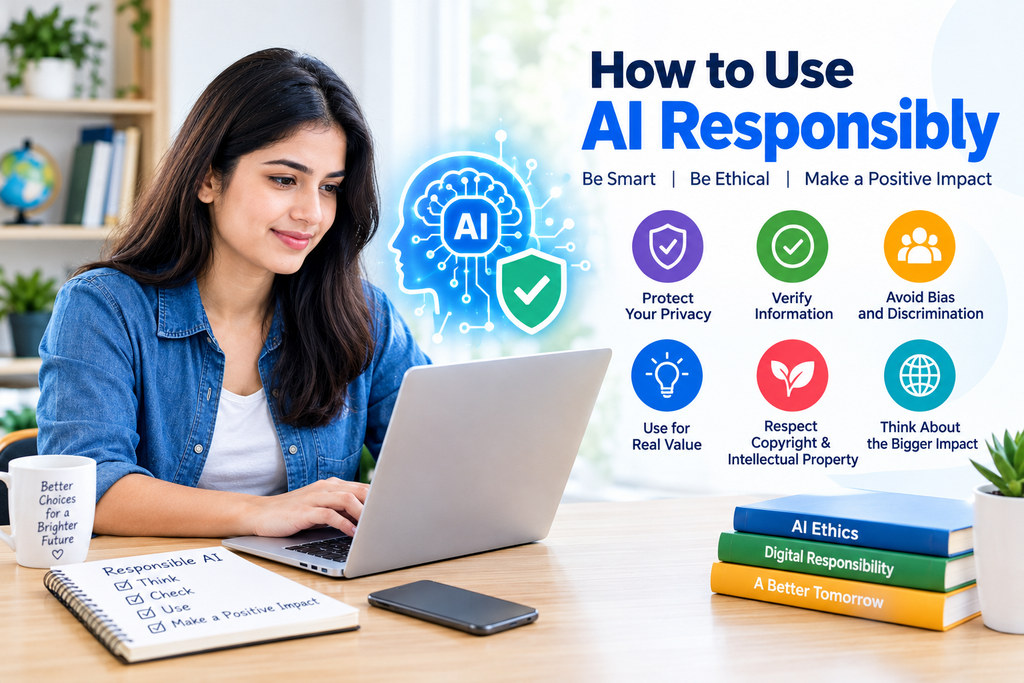
The importance of AI also means that people need to learn how to use it responsibly.
Here are some simple principles:
Verify Important Information
Don’t assume that every AI-generated answer is correct.
Protect Sensitive Information
Avoid entering confidential or sensitive information into AI tools unless you understand how that information is handled.
Keep Human Oversight
For important decisions, AI should support appropriate human judgment rather than automatically replace it.
Understand Limitations
Learn what an AI system can and cannot reliably do.
Keep Learning
AI technology changes rapidly, so continuing to learn is important.
Why Beginners Should Learn About AI
If you’re new to Artificial Intelligence, you might wonder whether learning AI is necessary.
You don’t need to become a programmer immediately.
Start by learning:
- What AI means
- How Machine Learning works
- What Deep Learning is
- How generative AI works
- Where AI is used
- What AI can and cannot do
- How to use AI tools responsibly
Understanding these fundamentals can make modern technology much easier to understand.
Read:- “step-by-step beginner roadmap for learning AI”
The Future Importance of Artificial Intelligence
AI is likely to remain an important technology as businesses, governments, researchers, educators, and individuals continue experimenting with new applications.
Current developments include increasingly capable generative AI and the exploration of AI systems that can handle more complex, multi-step workflows. IBM’s 2026 business research notes that organizations are increasingly exploring agentic AI alongside broader AI applications.
However, the future impact of AI will depend on more than technological progress.
It will also depend on:
- Education
- Skills
- Responsible development
- Data quality
- Privacy
- Security
- Regulation
- Human oversight
- Public understanding
In other words, the question isn’t simply “How powerful will AI become?”
It is also “How effectively and responsibly will people use AI?”
Frequently Asked Questions About the Importance of AI
Why is Artificial Intelligence important?
Artificial Intelligence is important because it can automate suitable tasks, analyze large amounts of information, support decision-making, increase productivity, personalize digital experiences, and help address complex problems.
Why is AI important in everyday life?
AI is already used in smartphones, search engines, navigation, recommendation systems, voice assistants, online shopping, social media, email filtering, and many other everyday technologies.
Why is AI important for businesses?
AI can help businesses automate workflows, analyze data, improve customer experiences, forecast demand, support decisions, and increase operational efficiency.
Why is AI important for students?
AI can provide learning assistance, explanations, practice materials, language support, and research assistance. Students should also learn to evaluate AI-generated information critically rather than simply accepting its answers.
Is AI important for the future of jobs?
Yes. AI is changing the tasks people perform and the skills employers need. Some tasks may be automated, while AI can also complement workers and contribute to new tasks and occupations.
Do I need coding skills to learn AI?
No. Beginners can start with AI concepts, applications, AI tools, and AI literacy before learning programming or advanced technical subjects.
What are the main benefits of AI?
Major benefits include automation, productivity improvements, data analysis, personalization, decision support, accessibility, and assistance with complex problems.
What are the risks of AI?
Important risks include privacy concerns, bias, inaccurate outputs, cybersecurity issues, job displacement, overdependence, and challenges involving governance and accountability.
Final Thoughts
The question “Why is Artificial Intelligence important in today’s world?” has a simple answer: AI is becoming a powerful general-purpose technology that can influence how people work, learn, communicate, create, and solve problems.
Its importance comes from its ability to process information, recognize patterns, automate suitable tasks, support decisions, and assist humans across a wide range of industries.
From healthcare and education to business, science, transportation, cybersecurity, and everyday digital services, AI is already making a measurable difference.
But understanding AI should not be limited to its benefits. Responsible AI use requires awareness of its limitations, including inaccurate outputs, privacy concerns, bias, security risks, and possible changes to employment.
For beginners, the most valuable first step is simply to understand the fundamentals.
You don’t need to become an AI expert overnight. Start by learning what AI is, how it works, where it is used, what its benefits are, and how to use AI responsibly.
As AI continues to develop, AI literacy can help you make more informed decisions about the technology that is increasingly becoming part of everyday life.
Key Takeaways
- AI is becoming an important general-purpose technology.
- AI can automate suitable repetitive tasks.
- AI can help increase productivity.
- AI can analyze large amounts of information.
- AI can support human decision-making.
- AI is being applied in healthcare and scientific research.
- AI is changing education and learning.
- Businesses use AI for automation, analysis, customer experience, and forecasting.
- AI is already present in many everyday digital services.
- AI is changing workplace tasks and skill requirements.
- AI literacy is becoming increasingly valuable.
- Responsible human oversight remains important.
Call to Action
Hope you liked our guide Why Artificial Intelligence is important in today’s world?
If you’re just starting, don’t miss our previous blogs:
👉 Blog 3: Types of Artificial Intelligence Explained for Beginners
👉 Blog 4: AI vs Machine Learning vs Deep Learning – A Beginner-Friendly Guide
👉 Blog 5: 10 Real-Life Examples of AI (Artificial Intelligence) in Everyday Life
Follow NextGenAIToolNest for more AI guides, automation tips, and online earning strategies.
Why Artificial Intelligence is important?
5 Comments