
 By
How to Start Learning AI
Introduction-
Learning artificial intelligence (AI) may seem complicated at first, especially if you have no technical background. However, with the right learning path, beginner-friendly tools, and consistent practice, anyone can start learning AI step by step. You do not need to become a programmer overnight or purchase expensive courses to begin.
In this complete beginner’s guide, you will discover how to start learning AI in 2026, which skills to learn first, the best free resources, and practical projects that can help you build your knowledge.
Whether you are a student, working professional, blogger, business owner, or curious learner, this beginner AI roadmap will help you take your first steps toward understanding and using artificial intelligence.
What Is Artificial Intelligence?
Artificial intelligence is a field of computer science focused on creating systems that can perform tasks commonly associated with human intelligence. These tasks include understanding language, recognizing images, identifying patterns, generating content, and making predictions.
For example, AI powers chatbots, voice assistants, recommendation systems, translation tools, and many modern productivity applications.
If you are new to the subject, start by reading our guide: What Is Artificial Intelligence? A Beginner’s Guide. It explains the fundamental concepts in simple language.
For a more detailed introduction, visit IBM’s guide to artificial intelligence, which explains AI concepts and their practical applications.
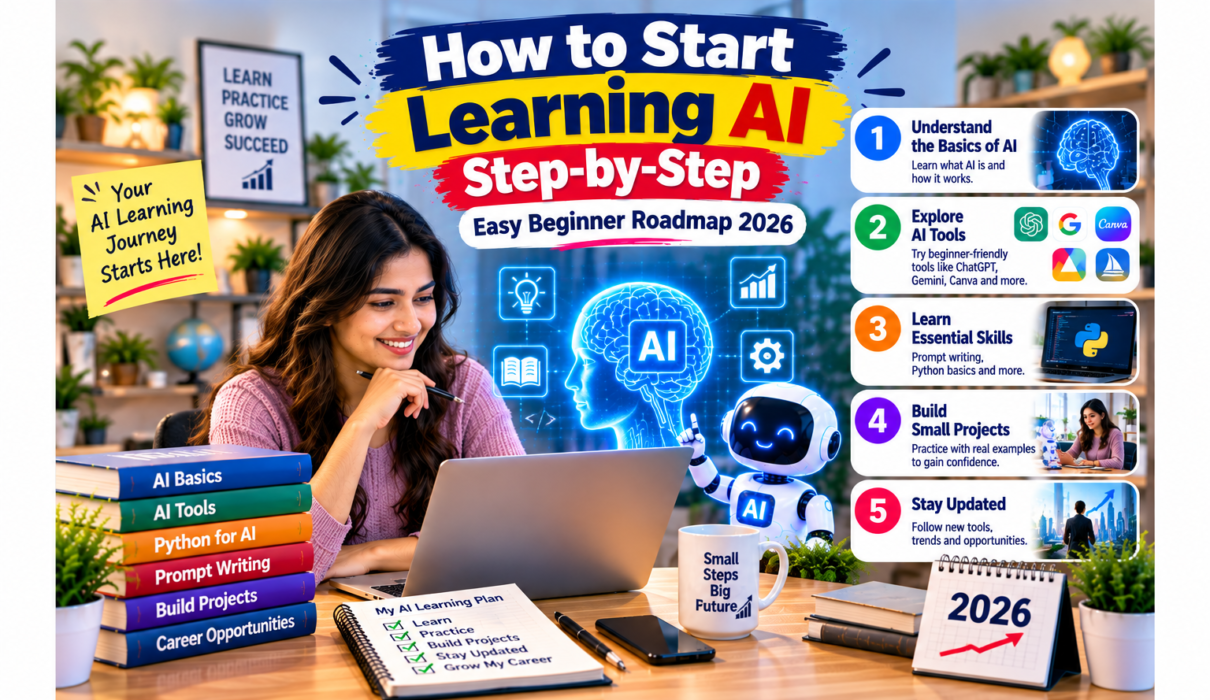
How to start learning AI.
Why Should Beginners Learn AI in 2026?

AI is becoming increasingly useful in education, business, healthcare, marketing, software development, research, and everyday life. Learning how to use AI can help you complete tasks more efficiently and understand emerging technologies.
Here are some reasons to begin learning AI:
- Improve productivity: Use AI tools to brainstorm ideas, summarize information, and organize work.
- Develop useful skills: Learn how AI tools work and how to apply them to practical problems.
- Explore career opportunities: Build foundational knowledge for further study in data analysis, machine learning, automation, or AI development.
- Support creativity: Experiment with writing, images, presentations, and other creative tasks.
- Understand technology: Learn about AI’s limitations, potential biases, privacy concerns, and responsible use.
Remember that learning AI does not guarantee a job or a particular income. Your opportunities will depend on your skills, experience, portfolio, and the needs of employers or customers.
For more context, read our article: Why Artificial Intelligence Is Important in Today’s World.
AI learning roadmap for beginners.
How to start learning AI.
How to Start Learning AI Step by Step
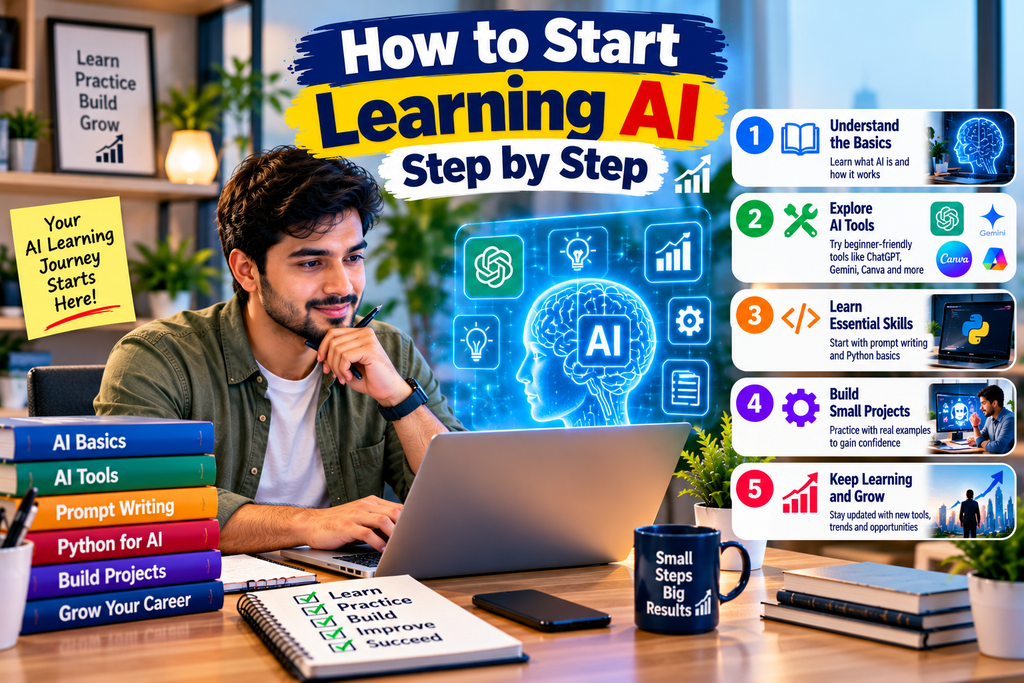
Follow these eight steps to build your AI knowledge from the ground up.
Step 1: Understand the Basics of AI
Your first step is to understand what AI is, what it can do, and where it is used.
Begin with these essential concepts:
- Artificial intelligence
- Machine learning
- Deep learning
- Generative AI
- Natural language processing
- Computer vision
You do not need to master every technical term immediately. Focus on understanding the basic ideas and recognizing examples from everyday life.
For instance, a recommendation system may suggest videos based on your viewing history, while a generative AI tool can produce a draft of an article from a text prompt.
Practical activity: Write down five examples of AI you encounter in daily life. Explain what each system does and how it might be useful.
Read our related guide: 10 Amazing Real-Life Examples of AI in Everyday Life.
You can also explore Elements of AI, a beginner-friendly educational course that introduces artificial intelligence concepts.
How to start learning AI.
Step 2: Learn the Difference Between AI, Machine Learning, and Deep Learning
These terms are closely related, but they do not mean exactly the same thing.
- Artificial intelligence: The broad field of building systems that perform tasks associated with intelligence.
- Machine learning: A branch of AI in which systems learn patterns from data.
- Deep learning: A type of machine learning that uses multilayered neural networks to learn complex patterns.
Understanding these differences will help you follow tutorials and choose the right learning materials.
Read our detailed guide: AI vs Machine Learning vs Deep Learning: A Beginner-Friendly Guide.
Once you understand the fundamentals, you can explore Google’s Machine Learning Crash Course. It offers structured lessons, visual explanations, and practical exercises for learners who want to progress beyond basic AI concepts.
How to start learning AI.
Step 3: Start Using Beginner-Friendly AI Tools
You can begin exploring AI without writing code. Try accessible tools for writing, research, brainstorming, image creation, or productivity.
Some options to explore include:
- ChatGPT: Brainstorm ideas, ask questions, and practice explaining concepts.
- Google Gemini: Explore research assistance and AI-supported tasks.
- Canva: Experiment with design and supported AI-powered creative features.
- Claude: Practice summarizing, analyzing, and drafting text.
- Google Teachable Machine: Experiment with simple machine-learning models using examples.
Features and free usage limits can change, so check each tool’s official website before signing up.
Visit the official websites to explore their features:
Beginner tip: Choose one tool and learn to use it well before trying several others. Start with a small task, such as creating a study plan, summarizing a public article, or brainstorming blog ideas.
For more recommendations, visit our guide: 10 Best AI Tools for Beginners (Free & Easy to Use in 2026).
Free AI courses for beginners.
How to start learning AI.
Step 4: Learn Prompt Writing
A prompt is the instruction or question you give an AI system. Learning to write clear prompts can help you get more useful results.
A good prompt often includes four elements:
- Role: Explain the perspective you want the AI to adopt.
- Task: State exactly what you want it to do.
- Context: Provide relevant background information.
- Format: Describe the output you need.
For example, instead of writing:
“Explain AI.”
Try this:
“Explain artificial intelligence to a complete beginner in 200 words. Use simple English, include three everyday examples, and finish with a short summary.”
The second prompt provides clearer instructions and a defined output.
Practice prompts for different tasks, including research, learning, writing, and planning. Compare the results and refine your instructions when necessary.
For additional guidance, explore OpenAI’s prompting guide, which explains how to structure instructions for AI models.
However, remember that a well-written prompt does not guarantee a correct answer. Verify important facts using reliable sources.
How to start learning AI.
Step 5: Learn Basic Python Programming
If your goal is to understand how AI models are built or eventually work in machine learning, learning Python is a useful next step.
Python is widely used for data analysis, automation, machine learning, and AI development. You can start with basic programming concepts before studying advanced algorithms.
Focus on learning:
- Variables and data types
- Lists and dictionaries
- Conditional statements
- Loops
- Functions
- Basic file handling
- Working with data
You do not need to learn everything at once. Begin by writing small programs, such as a calculator, a simple quiz, or a program that organizes a list of expenses.
Two useful learning resources are:
- Python Official Tutorial: Learn Python’s basic programming concepts.
- freeCodeCamp: Explore free programming tutorials and practical coding exercises.
If your immediate goal is simply to use AI tools in your daily life, you can postpone programming. If you want to become an AI developer or machine-learning practitioner, programming will become increasingly important.
Free AI courses for beginners.
How to start learning AI.
Step 6: Explore Data and Machine Learning
After learning the basics of Python, start exploring data and machine learning.
Machine learning involves finding patterns in data and using those patterns to make predictions or decisions. For example, a model might estimate house prices based on previous sales data or classify images into different categories.
Start with these concepts:
- Datasets and features
- Training and testing data
- Classification
- Regression
- Model accuracy
- Overfitting and generalization
You can begin with small, publicly available datasets and simple models rather than complicated projects.
Recommended resource: Google’s Machine Learning Crash Course.
Another useful resource is Kaggle Learn, which provides practical learning material on Python, data analysis, and machine learning.
Do not worry if these concepts feel difficult initially. Work through one topic at a time and practice with simple examples.
How to start learning AI.
Step 7: Build Small AI Projects
Practical projects help turn theoretical knowledge into usable skills. You do not need to build a sophisticated AI system to get started.
Try these beginner-friendly projects:
Project 1: AI-assisted study planner
Use an AI assistant to create a weekly study schedule. Review the plan and adjust it to match your actual commitments.
Project 2: Blog topic generator
Create a list of blog ideas for a specific audience. Organize the ideas by topic and evaluate which ones best meet your readers’ needs.
Project 3: Simple image classifier
Use Google Teachable Machine to experiment with training a model to recognize a few categories of images.
Project 4: Basic Python quiz
Write a small Python program that asks multiple-choice questions, checks answers, and displays a score.
Project 5: Data exploration
Use a public dataset to create a simple chart and explain the pattern you observe.
For each project, document your goal, the tools you used, what worked, what failed, and what you learned. This will help you track your progress and build a portfolio over time.
How to start learning AI.
Step 8: Learn to Use AI Responsibly
Learning AI also means understanding its limitations and potential risks.
AI-generated information can be incorrect, outdated, biased, or misleading. AI tools may also produce content that requires human review or may not be appropriate for a particular situation.
Follow these responsible-use practices:
- Verify important information using trustworthy sources.
- Avoid entering passwords, confidential documents, or sensitive personal information into tools unless you understand their data-handling policies and have appropriate authorization.
- Review AI-generated work before publishing or submitting it.
- Respect copyright, privacy, and other people’s intellectual property.
- Be transparent about AI use when required by your school, workplace, or publication.
- Use human judgment for important decisions.
Read our related article: How Beginners Can Use AI Responsibly.
For additional guidance, consult UNESCO’s resources on artificial intelligence and its work on responsible, human-centered AI.
AI learning roadmap for beginners.
Free AI courses for beginners.
A 30-Day AI Learning Roadmap for Beginners
If you are unsure how to organize your learning, use this simple four-week plan. Adjust the schedule to your available time and prior experience.
| Week | What to Learn | Practical Activity |
|---|---|---|
| Week 1 | AI fundamentals and everyday applications | Identify five AI applications and explain how they work at a basic level |
| Week 2 | Beginner-friendly AI tools and prompt writing | Complete five tasks with one AI assistant and improve your prompts |
| Week 3 | Python fundamentals or no-code AI experiments | Build a small Python program or experiment with Teachable Machine |
| Week 4 | A beginner project and responsible AI | Complete one project, verify its results, and document what you learned |
Try to spend 20–45 minutes learning on most days. Consistency matters more than rushing through a large amount of material.
At the end of 30 days, you should have a stronger understanding of AI fundamentals, experience using at least one AI tool, and a small project or practical exercise to show for your effort. Your progress will depend on your starting point and how consistently you practice.
AI learning roadmap for beginners.
Free AI courses for beginners.
Best Free Resources to Learn Artificial Intelligence
Free AI courses for beginners.
You do not need to purchase an expensive course to begin. The following resources provide useful starting points.
1. Google Machine Learning Crash Course
Best for learners ready to explore machine learning concepts through structured lessons and exercises.
Website: https://developers.google.com/machine-learning/crash-course
2. Google Teachable Machine
Best for beginners who want to experiment with simple machine-learning models without starting with code.
Website: https://teachablemachine.withgoogle.com/
3. Python Official Tutorial
Best for learners who want to understand Python programming and eventually work on technical AI projects.
Website: https://docs.python.org/3/tutorial/
4. Kaggle Learn
Best for practical introductions to Python, data analysis, and machine learning.
Website: https://www.kaggle.com/learn
5. Elements of AI
Best for people who want an accessible introduction to the ideas behind artificial intelligence.
Website: https://www.elementsofai.com/
Choose resources that match your current level rather than trying to complete all of them at once.
For a more detailed list, read our article: Free Resources to Learn Artificial Intelligence: The Best Beginner’s Guide.
Learn artificial intelligence for beginners.
How to learn AI from scratch.
Free AI courses for beginners.
Common Mistakes Beginners Should Avoid
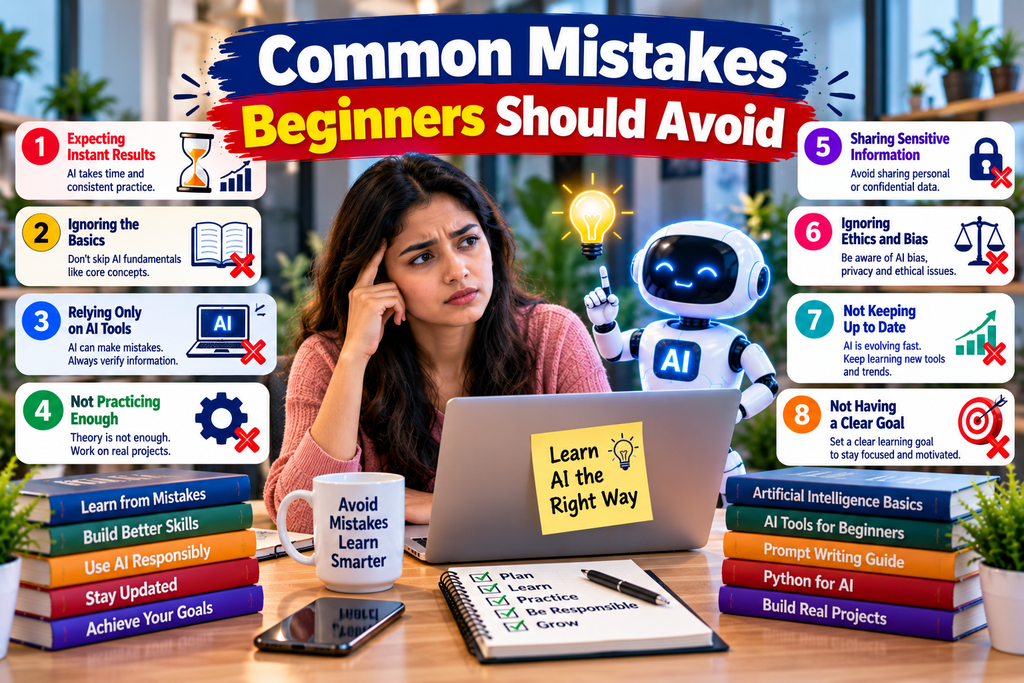
When learning AI, avoid these common mistakes:
1. Trying to learn everything at once
AI includes many subjects. Start with fundamentals and expand your knowledge gradually.
2. Depending entirely on AI-generated answers
Use AI as a learning assistant, not as your only source of truth. Check important claims against reliable references.
3. Skipping hands-on practice
Watching tutorials is helpful, but you will learn more by completing small exercises and projects.
4. Buying expensive courses too early
Explore free resources first. Consider paid training only when you understand your goals and know what additional instruction you need.
5. Expecting instant results
Building technical AI skills takes time. Set realistic goals and measure progress through practical work rather than the number of videos watched.
6. Ignoring privacy and ethics
Learn how to protect data, recognize limitations, and evaluate AI-generated outputs from the beginning.
Learn artificial intelligence for beginners.
How to learn AI from scratch.
Frequently Asked Questions About Learning AI
Can I learn AI without coding?
Yes. You can start by learning AI concepts and using no-code tools. If you later want to build models or pursue technical AI roles, learning Python and basic mathematics will be helpful.
How long does it take to learn AI?
You can learn introductory concepts and begin using AI tools within a few weeks. Developing programming, machine-learning, and model-building skills generally requires a longer period of consistent study and practice.
Is AI difficult for beginners?
AI can seem challenging because it covers many different subjects. However, starting with simple explanations, beginner-friendly tools, and practical projects makes the learning process more manageable.
Do I need mathematics to learn AI?
You do not need advanced mathematics to start using AI tools. For technical machine learning, a foundation in algebra, statistics, probability, and eventually linear algebra will be useful.
Which AI tool should a beginner learn first?
Start with a tool that matches your goal. A conversational AI assistant is useful for learning and brainstorming, while Teachable Machine is a good starting point for no-code machine-learning experiments.
Can learning AI help me get a job?
AI knowledge can support career development, but employment depends on the role, your practical skills, experience, portfolio, and other qualifications. Build projects and learn the skills relevant to the opportunities you want to pursue.
Learn artificial intelligence for beginners.
How to learn AI from scratch.
Conclusion: Start Your AI Learning Journey Today
Learning artificial intelligence does not have to be overwhelming. Begin by understanding the basics, experimenting with accessible tools, practicing prompt writing, and completing small projects. When you are ready to move into technical AI, learn Python and explore machine learning step by step.
Use the 30-day roadmap in this guide to create a manageable learning routine. Focus on understanding concepts, checking information, practicing consistently, and using AI responsibly.
Your first goal is not to master all of AI in 30 days. It is to build a strong foundation and develop the habit of learning.
Start today by choosing one beginner-friendly AI tool, completing one useful task, and writing down what you learned. Small steps can lead to meaningful progress over time.
Learn artificial intelligence for beginners.
How to learn AI from scratch.
Call to Action
If you’re just starting, don’t miss one of our previous guide:
👉Blog 9: 10 Best Free AI Tools for Beginners in 2026
👉Follow NextGenAIToolNest for more AI guides, automation tips, and online earning strategies.
3 Comments